苇 (wěi) means "Reed" in Chinese. It has 7 strokes with the radical 艹.
Rated 3.5/5 in difficulty (challenging).
Appears in 3+ common words including 芦苇 (lú wěi), 苇席 (wěi xí), 苇丛 (wěi cóng).
Due to its 7 strokes, Hanzi Writer's error detection shows 苇 requires focused practice — most learners need 10+ attempts for consistent accuracy.
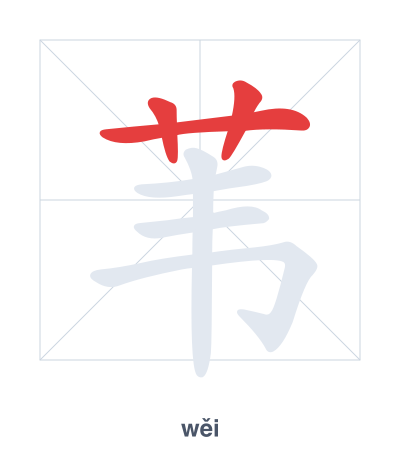
Open Hanzi Writer to see the animated stroke order and practice writing 苇 with real-time feedback.
The character 苇 (wěi) is written with 7 strokes. Follow the standard Chinese stroke order: top to bottom, left to right, outside before inside. The radical 艹 is one of its key components.
Practice the correct stroke order with the Hanzi Writer app to see animated stroke-by-stroke guidance with real-time feedback.
苇 means Reed.
苇 is a phono-semantic compound formed with the grass radical 艹 (indicating a plant) and the phonetic component 韦 (wěi), which originally referred to soft leather but here contributes sound. The character means 'reed', a tall grass-like plant that grows in wetlands.
💡 Memory Tip: Picture a reed with a tuft of grass on top (艹) and a winding, flexible stem shaped like the character 韦, swaying by the water's edge.
河边有芦苇。
hé biān yǒu lú wěi
There are reeds by the river.
这张苇席很凉快。
zhè zhāng wěi xí hěn liáng kuài
This reed mat is very cool.
小鸟在苇丛里。
xiǎo niǎo zài wěi cóng lǐ
The little bird is in the reeds.
Open Hanzi Writer to see the animated stroke order and practice writing 苇 with real-time feedback.
✨ Animated stroke order · Handwriting recognition · HSK-graded practice · Free to use
苇 is a top-bottom structure. The top radical 艹 (grass) indicates the character relates to plants, and the bottom part 韦 (wéi) contributes to the sound, making 苇 a semantic-phonetic compound meaning "reed" (a type of grass).