栌 (lú) means "smoke tree; bracket (in architecture)" in Chinese. It has 9 strokes with the radical 木.
Rated 4/5 in difficulty (challenging).
Appears in 3+ common words including 黄栌 (huáng lú), 栌叶 (lú yè), 栌木 (lú mù).
Due to its 9 strokes, Hanzi Writer's error detection shows 栌 requires focused practice — most learners need 10+ attempts for consistent accuracy.
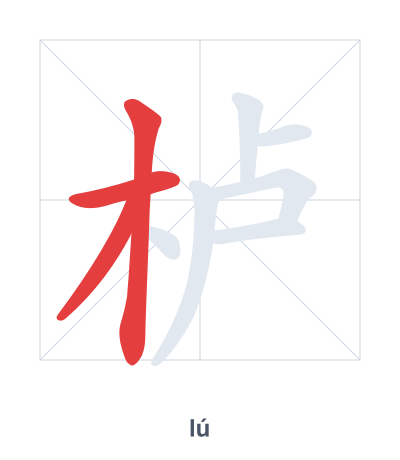
Open Hanzi Writer to see the animated stroke order and practice writing 栌 with real-time feedback.
The character 栌 (lú) is written with 9 strokes. Follow the standard Chinese stroke order: top to bottom, left to right, outside before inside. The radical 木 is one of its key components.
Practice the correct stroke order with the Hanzi Writer app to see animated stroke-by-stroke guidance with real-time feedback.
栌 means smoke tree; bracket (in architecture).
栌 is a phono-semantic compound combining the radical 木 (wood/tree) with 卢 (lú), which provides the pronunciation. The smoke tree is a type of wood, and the architectural bracket is a wooden support, so the tree radical directly links to the meaning. The right component 卢 originally depicted a hut or vessel, reinforcing the idea of a support structure.
💡 Memory Tip: Picture a wooden bracket (木) shaped like a tiny hut (卢) holding up a heavy roof.
山上有许多黄栌树。
shān shàng yǒu xǔ duō huáng lú shù
There are many smoke trees on the mountain.
秋天黄栌叶变红了。
qiū tiān huáng lú yè biàn hóng le
The leaves of the smoke tree turn red in autumn.
这种木头叫栌木。
zhè zhǒng mù tou jiào lú mù
This wood is called sumac wood.
Open Hanzi Writer to see the animated stroke order and practice writing 栌 with real-time feedback.
✨ Animated stroke order · Handwriting recognition · HSK-graded practice · Free to use
栌 is composed of the radical 木 (wood/tree) on the left, and the phonetic component 卢 (lú) on the right. The wood radical directly links to its meanings of a type of tree (smoke tree) and a wooden architectural bracket. The right side provides pronunciation but does not contribute to meaning.