犁 (lí) means "plow" in Chinese. It has 11 strokes with the radical 牛.
Rated 4.2/5 in difficulty (advanced).
Appears in 3+ common words including 犁地 (lí dì), 木犁 (mù lí), 犁田 (lí tián).
Due to its 11 strokes, Hanzi Writer's error detection shows 犁 requires focused practice — most learners need 10+ attempts for consistent accuracy.
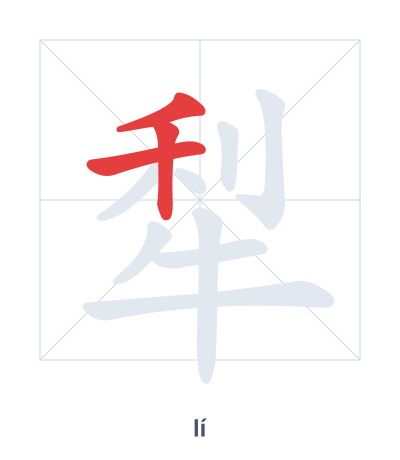
Open Hanzi Writer to see the animated stroke order and practice writing 犁 with real-time feedback.
The character 犁 (lí) is written with 11 strokes. Follow the standard Chinese stroke order: top to bottom, left to right, outside before inside. The radical 牛 is one of its key components.
Practice the correct stroke order with the Hanzi Writer app to see animated stroke-by-stroke guidance with real-time feedback.
犁 means plow.
| Character | 犁 |
| Pinyin | lí (li) |
| Meaning | plow |
| Strokes | 11 |
| Radical | 牛 |
| Difficulty | 4.2/5 |
犁 combines the radical 牛 (ox) with 利 (sharp/benefit). 利 itself is made of 禾 (grain) and 刀 (knife), meaning a sharp tool. Together, the character depicts an ox using a sharp implement to plow the fields.
💡 Memory Tip: Picture a strong ox (牛) pulling a sharp knife (利) through the earth, carving neat furrows with a plow.
农民在春天犁地。
nóng mín zài chūn tiān lí dì
Farmers plow the land in spring.
这是一个古老的木犁。
zhè shì yí gè gǔ lǎo de mù lí
This is an ancient wooden plow.
牛在田里辛苦地犁田。
niú zài tián lǐ xīn kǔ dì lí tián
The ox is plowing the field hard.
Open Hanzi Writer to see the animated stroke order and practice writing 犁 with real-time feedback.
✨ Animated stroke order · Handwriting recognition · HSK-graded practice · Free to use
犁 is made of two parts: the top is 牛 (cow/ox) and the bottom is 利 (sharp/benefit). The cow radical shows that plowing was traditionally done with oxen, while 利 suggests the sharp blade of the plow that cuts through the soil.