铼 (lái) means "Rhenium" in Chinese. It has 12 strokes with the radical 钅.
Rated 4.2/5 in difficulty (advanced).
Appears in 3+ common words including 金属铼 (jīn shǔ lái), 铼合金 (lái hé jīn), 铼的用途 (lái de yòng tú).
Due to its 12 strokes, Hanzi Writer's error detection shows 铼 requires focused practice — most learners need 10+ attempts for consistent accuracy.
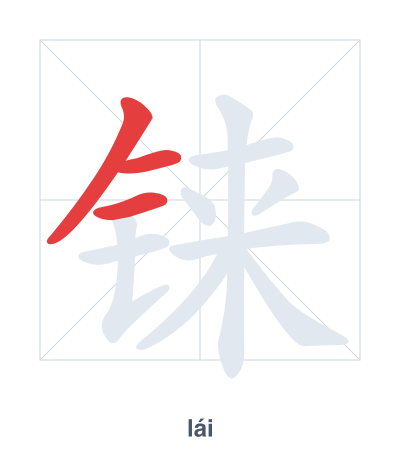
Open Hanzi Writer to see the animated stroke order and practice writing 铼 with real-time feedback.
The character 铼 (lái) is written with 12 strokes. Follow the standard Chinese stroke order: top to bottom, left to right, outside before inside. The radical 钅 is one of its key components.
Practice the correct stroke order with the Hanzi Writer app to see animated stroke-by-stroke guidance with real-time feedback.
铼 means Rhenium.
铼 is a modern phono-semantic compound. The radical 钅 (metal) indicates it is a metallic element, while 来 (lái) provides the pronunciation. This character was created in the 20th century to name the chemical element rhenium.
💡 Memory Tip: Imagine a metal (钅) coin that comes (来) to you, representing the rare and valuable element rhenium.
铼的价格很贵。
lái de jià gé hěn guì
Rhenium is very expensive.
这种材料含有铼合金。
zhè zhǒng cái liào hán yǒu lái hé jīn
This material contains rhenium alloy.
铼的用途很广。
lái de yòng tú hěn guǎng
Rhenium has a wide range of uses.
Open Hanzi Writer to see the animated stroke order and practice writing 铼 with real-time feedback.
✨ Animated stroke order · Handwriting recognition · HSK-graded practice · Free to use
铼 is a left-right character. The left radical 钅 means metal, and the right part 来 (lái) provides the pronunciation. Together, they form the name of the metal rhenium.