莱 (lái) means "goosefoot; (used in transliterations like Rhine)" in Chinese. It has 10 strokes with the radical 艹.
Rated 4.2/5 in difficulty (advanced).
Appears in 3+ common words including 莱茵河 (lái yīn hé), 蓬莱 (péng lái), 莱菔 (lái fú).
Due to its 10 strokes, Hanzi Writer's error detection shows 莱 requires focused practice — most learners need 10+ attempts for consistent accuracy.
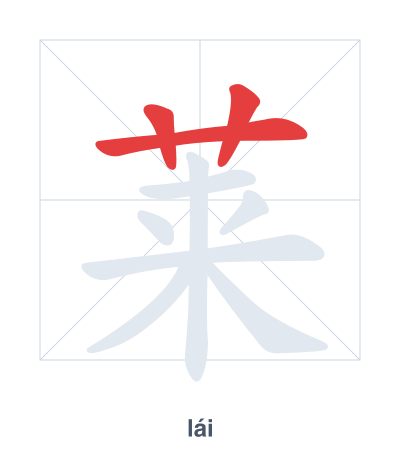
Open Hanzi Writer to see the animated stroke order and practice writing 莱 with real-time feedback.
The character 莱 (lái) is written with 10 strokes. Follow the standard Chinese stroke order: top to bottom, left to right, outside before inside. The radical 艹 is one of its key components.
Practice the correct stroke order with the Hanzi Writer app to see animated stroke-by-stroke guidance with real-time feedback.
莱 means goosefoot; (used in transliterations like Rhine).
莱 is a compound of the grass radical 艹 and 来, which gives the sound. It originally referred to a type of edible weed or goosefoot plant. Today it is also used in phonetic transliterations, such as '莱茵' for the Rhine River.
💡 Memory Tip: A goosefoot plant (艹) comes (来) sprouting out of the ground as a weed.
莱茵河的风景很美。
lái yīn hé de fēng jǐng hěn měi
The scenery of the Rhine is very beautiful.
蓬莱是一个旅游胜地。
péng lái shì yí gè lǚ yóu shèng dì
Penglai is a famous tourist destination.
莱菔其实就是萝卜。
lái fú qí shí jiù shì luó bo
Laifu is actually just another name for radish.
Open Hanzi Writer to see the animated stroke order and practice writing 莱 with real-time feedback.
✨ Animated stroke order · Handwriting recognition · HSK-graded practice · Free to use
The character 莱 has the radical 艹 (grass) on top, indicating it relates to plants. The bottom part is 来 (meaning "come"), which gives the pronunciation lái. Together, the grass radical suggests the original meaning of a plant called goosefoot.