菔 (fú) means "radish (used in 'laifu')" in Chinese. It has 11 strokes with the radical 艹.
Rated 4.2/5 in difficulty (advanced).
Appears in 3+ common words including 莱菔 (lái fú), 莱菔子 (lái fú zi), 莱菔汤 (lái fú tāng).
Due to its 11 strokes, Hanzi Writer's error detection shows 菔 requires focused practice — most learners need 10+ attempts for consistent accuracy.
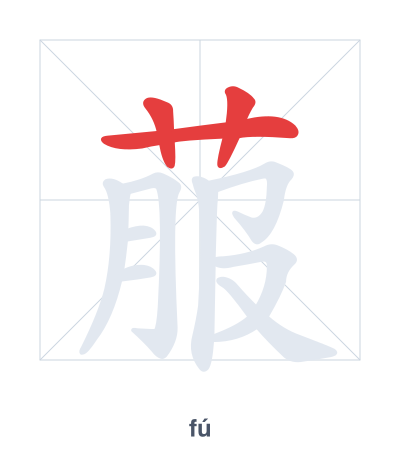
Open Hanzi Writer to see the animated stroke order and practice writing 菔 with real-time feedback.
The character 菔 (fú) is written with 11 strokes. Follow the standard Chinese stroke order: top to bottom, left to right, outside before inside. The radical 艹 is one of its key components.
Practice the correct stroke order with the Hanzi Writer app to see animated stroke-by-stroke guidance with real-time feedback.
菔 means radish (used in 'laifu').
This character is a phono-semantic compound combining the radical 艹 (grass/plant) with 服 (fú), which provides the pronunciation. It appears exclusively in the word 萝卜 (luóbo) meaning 'radish', where it signifies a specific type of root vegetable.
💡 Memory Tip: Picture a radish plant (艹) wearing a tiny outfit (服) because it's dressed for the harvest.
莱菔就是我们说的萝卜。
lái fú jiù shì wǒ men shuō de luó bo
Laifu is what we call radish.
莱菔子可以做中药。
lái fú zi kě yǐ zuò zhōng yào
Radish seeds can be used as Chinese herbal medicine.
冬天喝莱菔汤很暖和。
dōng tiān hē lái fú tāng hěn nuǎn huo
Drinking radish soup in winter is very warming.
Open Hanzi Writer to see the animated stroke order and practice writing 菔 with real-time feedback.
✨ Animated stroke order · Handwriting recognition · HSK-graded practice · Free to use
The character 菔 has the radical 艹 (grass) on top, showing it is a plant. The right part is 服 (fú), which gives the sound. Together, 菔 means radish, specifically in the word 莱菔 (láifú).