梾 (lái) means "cornel tree or dogwood" in Chinese. It has 11 strokes with the radical 木.
Rated 4.2/5 in difficulty (advanced).
Appears in 3+ common words including 梾木 (lái mù), 灯台梾 (dēng tái lái), 梾实 (lái shí).
Due to its 11 strokes, Hanzi Writer's error detection shows 梾 requires focused practice — most learners need 10+ attempts for consistent accuracy.
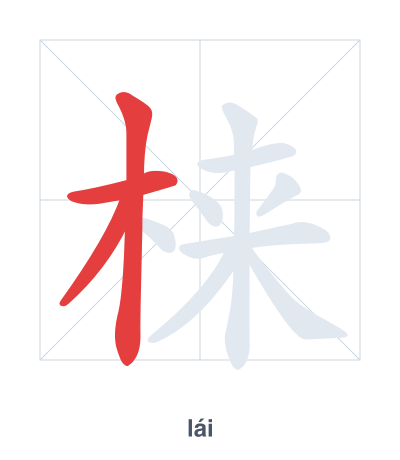
Open Hanzi Writer to see the animated stroke order and practice writing 梾 with real-time feedback.
The character 梾 (lái) is written with 11 strokes. Follow the standard Chinese stroke order: top to bottom, left to right, outside before inside. The radical 木 is one of its key components.
Practice the correct stroke order with the Hanzi Writer app to see animated stroke-by-stroke guidance with real-time feedback.
梾 means cornel tree or dogwood.
梾 is a phono-semantic compound: the radical 木 (tree) indicates it's a type of tree, while 来 (lái, 'to come') provides the pronunciation. Together they represent the cornel or dogwood tree, known for its hard wood and edible berries.
💡 Memory Tip: Picture a dogwood tree (木) that comes (来) to life each spring with bright red berries.
这种梾木很坚硬。
zhè zhǒng lái mù hěn jiān yìng
This dogwood is very hard.
公园里有灯台梾。
gōng yuán lǐ yǒu dēng tái lái
There are giant dogwood trees in the park.
梾实可以入药。
lái shí kě yǐ rù yào
Cornel fruit can be used in medicine.
Open Hanzi Writer to see the animated stroke order and practice writing 梾 with real-time feedback.
✨ Animated stroke order · Handwriting recognition · HSK-graded practice · Free to use
梾 is a left-right character. The left part 木 means 'tree,' indicating it is a type of tree. The right part 来 gives the pronunciation lái and adds no direct meaning, but together they refer to the cornel or dogwood tree.