蒉 (kuì) means "straw basket" in Chinese. It has 12 strokes with the radical 艹.
Rated 4.2/5 in difficulty (advanced).
Appears in 3+ common words including 蒉草 (kuì cǎo), 蒉席 (kuì xí), 蒉子 (kuì zi).
Due to its 12 strokes, Hanzi Writer's error detection shows 蒉 requires focused practice — most learners need 10+ attempts for consistent accuracy.
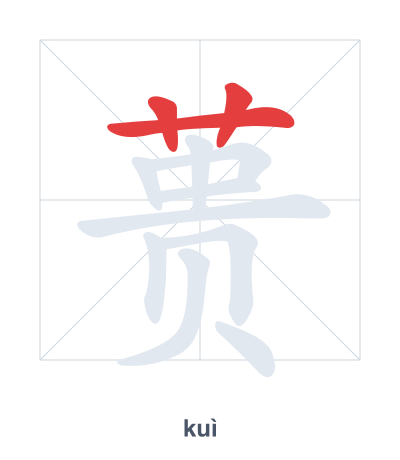
Open Hanzi Writer to see the animated stroke order and practice writing 蒉 with real-time feedback.
The character 蒉 (kuì) is written with 12 strokes. Follow the standard Chinese stroke order: top to bottom, left to right, outside before inside. The radical 艹 is one of its key components.
Practice the correct stroke order with the Hanzi Writer app to see animated stroke-by-stroke guidance with real-time feedback.
蒉 means straw basket.
蒉 is a phono-semantic compound: the radical 艹 (grass) indicates the basket is made from plant material, while 贵 (guì, expensive) provides the sound (though the modern reading is kuì). Ancient depictions of a straw basket show a woven container, and the character visually combines a grass cover with a valuable item inside.
💡 Memory Tip: Picture a fancy straw basket (艹) that's so expensive (贵) you'd exclaim 'Kui!' when you drop it.
这种蒉草很常见。
zhè zhǒng kuì cǎo hěn cháng jiàn
This type of straw is very common.
他坐在蒉席上。
tā zuò zài kuì xí shàng
He is sitting on a straw mat.
这是一个旧蒉子。
zhè shì yí gè jiù kuì zi
This is an old straw basket.
Open Hanzi Writer to see the animated stroke order and practice writing 蒉 with real-time feedback.
✨ Animated stroke order · Handwriting recognition · HSK-graded practice · Free to use
蒉 is composed of the grass radical 艹 on top and 贵 (expensive) below. The grass radical indicates the character is related to plant materials, and the whole character represents a straw basket. The bottom part 贵 likely serves as a phonetic component, though its pronunciation differs slightly from 蒉.