稞 (kē) means "highland barley" in Chinese. It has 13 strokes with the radical 禾.
Rated 4.2/5 in difficulty (advanced).
Appears in 3+ common words including 青稞 (qīng kē), 青稞酒 (qīng kē jiǔ), 青稞面 (qīng kē miàn).
Due to its 13 strokes, Hanzi Writer's error detection shows 稞 requires focused practice — most learners need 10+ attempts for consistent accuracy.
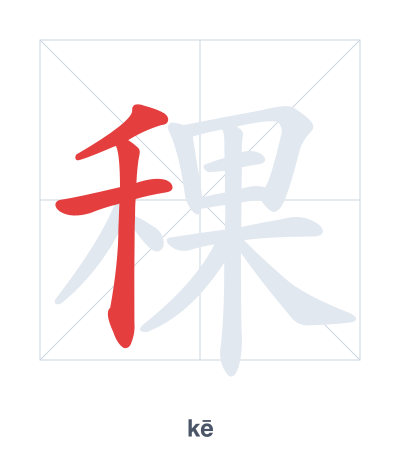
Open Hanzi Writer to see the animated stroke order and practice writing 稞 with real-time feedback.
The character 稞 (kē) is written with 13 strokes. Follow the standard Chinese stroke order: top to bottom, left to right, outside before inside. The radical 禾 is one of its key components.
Practice the correct stroke order with the Hanzi Writer app to see animated stroke-by-stroke guidance with real-time feedback.
稞 means highland barley.
稞 is a compound character combining the radical 禾 (grain) with 果 (fruit) as a phonetic component. Since highland barley is a type of grain, the 禾 radical indicates its category, while 果 provides the pronunciation kē (though 果 itself is pronounced guǒ).
💡 Memory Tip: Imagine a grain (禾) that grows fruit (果) on a stalk—that's highland barley, a hearty grain for high altitudes.
藏族人吃青稞。
zàng zú rén chī qīng kē
Tibetan people eat highland barley.
青稞酒很好喝。
qīng kē jiǔ hěn hǎo hē
Highland barley wine is very tasty.
青稞面很有营养。
qīng kē miàn hěn yǒu yíng yǎng
Highland barley flour is very nutritious.
Open Hanzi Writer to see the animated stroke order and practice writing 稞 with real-time feedback.
✨ Animated stroke order · Handwriting recognition · HSK-graded practice · Free to use
稞 is a left-right character. The left part, 禾, is the radical meaning 'grain', indicating that 稞 is a type of grain. The right part, 果, gives a clue to the pronunciation (though not exact) and visually suggests a 'fruit' or seed head, matching the barley plant.