坷 (kē/kě) means "uneven; bumpy" in Chinese. It has 8 strokes with the radical 土.
Rated 3.7/5 in difficulty (challenging).
Appears in 3+ common words including 坎坷 (kǎn kě), 土坷垃 (tǔ kē lā), 坷坎 (kě kǎn).
Due to its 8 strokes, Hanzi Writer's error detection shows 坷 requires focused practice — most learners need 10+ attempts for consistent accuracy.
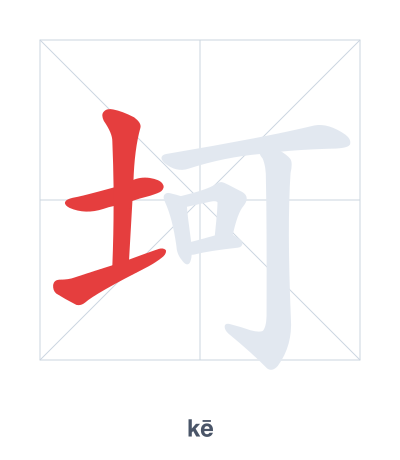
Open Hanzi Writer to see the animated stroke order and practice writing 坷 with real-time feedback.
The character 坷 (kē/kě) is written with 8 strokes. Follow the standard Chinese stroke order: top to bottom, left to right, outside before inside. The radical 土 is one of its key components.
Practice the correct stroke order with the Hanzi Writer app to see animated stroke-by-stroke guidance with real-time feedback.
坷 means uneven; bumpy.
This is a polyphonic character with readings: kē, kě.
坷 is a phono-semantic compound. The left radical 土 (earth, soil) hints at the meaning of uneven ground, while the right component 可 (kě) primarily provides the pronunciation. Together, they depict soil that is rough or bumpy, not smooth and flat.
💡 Memory Tip: Imagine a patch of earth (土) where every step you take, you say 'kě' (可) because it's so bumpy you might fall—every step is a possible tumble.
他的生活很坎坷。
tā de shēng huó hěn kǎn kě
His life has been full of ups and downs.
地上有许多土坷垃。
dì shàng yǒu xǔ duō tǔ kē lā
There are many clods of earth on the ground.
这条路到处是坷坎。
zhè tiáo lù dào chù shì kě kǎn
This road is full of bumps.
Open Hanzi Writer to see the animated stroke order and practice writing 坷 with real-time feedback.
✨ Animated stroke order · Handwriting recognition · HSK-graded practice · Free to use
坷 is made of the radical 土 (earth) on the left and 可 (kě, meaning 'can' or 'able') on the right. The 土 radical connects the character to earth or ground, while 可 adds the sound and hints at unevenness in the ground, like something that can trip you.