攥 (zuàn) means "to grip or clutch" in Chinese. It has 23 strokes with the radical 扌.
Rated 4.2/5 in difficulty (advanced).
Appears in 3+ common words including 攥紧 (zuàn jǐn), 攥住 (zuàn zhù), 攥着 (zuàn zhe).
Due to its 23 strokes, Hanzi Writer's error detection shows 攥 requires focused practice — most learners need 10+ attempts for consistent accuracy.
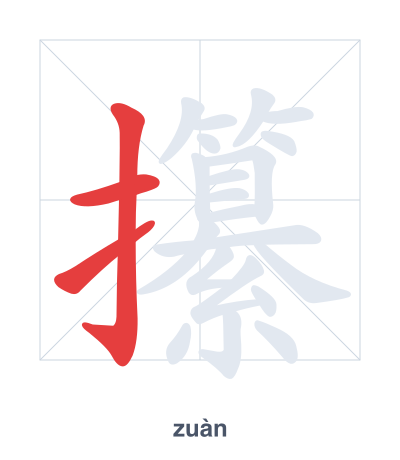
Open Hanzi Writer to see the animated stroke order and practice writing 攥 with real-time feedback.
The character 攥 (zuàn) is written with 23 strokes. Follow the standard Chinese stroke order: top to bottom, left to right, outside before inside. The radical 扌 is one of its key components.
Practice the correct stroke order with the Hanzi Writer app to see animated stroke-by-stroke guidance with real-time feedback.
攥 means to grip or clutch.
This compound character combines the hand radical 扌 (hand) with 纂 (zuǎn, meaning 'to compile' or 'gather'), which provides phonetic and semantic hints—like gathering threads tightly into a fist. The structure visually suggests a hand gripping something firmly, compressing it together.
💡 Memory Tip: Picture a hand (扌) grabbing a bundle of silk threads (糸) so tightly that your eyes (目) bulge out big (大) from the effort of clutching.
他攥紧了手中的钱。
tā zuàn jǐn le shǒu zhōng de qián
He gripped the money in his hand tightly.
请攥住这根绳子。
qǐng zuàn zhù zhè gēn shéng zi
Please grip this rope.
他手里攥着一张票。
tā shǒu lǐ zuàn zhe yī zhāng piào
He is clutching a ticket in his hand.
Open Hanzi Writer to see the animated stroke order and practice writing 攥 with real-time feedback.
✨ Animated stroke order · Handwriting recognition · HSK-graded practice · Free to use
攥 combines the hand radical 扌 (hand) on the left with the phonetic component 纂 (zuǎn, meaning to compile or edit) on the right. The hand radical indicates the action of gripping or clutching, while 纂 adds the sound and a sense of gathering or holding things together. This structure shows that 攥 is a hand action involving holding something firmly, like compiling items into a tight bunch.