迳 (jìng) means "Directly; path" in Chinese. It has 8 strokes with the radical 辶.
Rated 3.7/5 in difficulty (challenging).
Appears in 3+ common words including 迳直 (jìng zhí), 迳自 (jìng zì), 迳取 (jìng qǔ).
Due to its 8 strokes, Hanzi Writer's error detection shows 迳 requires focused practice — most learners need 10+ attempts for consistent accuracy.
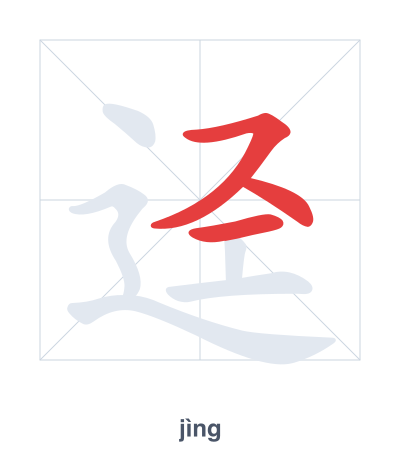
Open Hanzi Writer to see the animated stroke order and practice writing 迳 with real-time feedback.
The character 迳 (jìng) is written with 8 strokes. Follow the standard Chinese stroke order: top to bottom, left to right, outside before inside. The radical 辶 is one of its key components.
Practice the correct stroke order with the Hanzi Writer app to see animated stroke-by-stroke guidance with real-time feedback.
迳 means Directly; path.
迳 is a compound of 辶 (walking) and 巠 (a phonetic component that originally depicted vertical warp threads on a loom, symbolizing straightness). Together, the character conveys the idea of a straight path or going directly.
💡 Memory Tip: Picture a speedy walker (辶) following a no-nonsense straight line (like the shape of 巠) to reach the destination directly.
他迳直走进了办公室。
tā jìng zhí zǒu jìn le bàn gōng shì
He walked straight into the office.
她迳自坐了下来。
tā jìng zì zuò le xià lái
She sat down directly.
我们可以迳取捷径。
wǒ men kě yǐ jìng qǔ jié jìng
We can take a shortcut directly.
Open Hanzi Writer to see the animated stroke order and practice writing 迳 with real-time feedback.
✨ Animated stroke order · Handwriting recognition · HSK-graded practice · Free to use
The character 迳 is made of the radical 辶 (walking) on the left and the phonetic component 巠 (jīng) on the right. The radical 辶 relates to movement or a path, while 巠 originally meant 'vertical thread,' suggesting a straight line, so together they mean 'directly' or 'path.'