肼 (jǐng) means "hydrazine" in Chinese. It has 8 strokes with the radical 月.
Rated 3.7/5 in difficulty (challenging).
Appears in 3+ common words including 肼基 (jǐng jī), 苯肼 (běn jǐng), 甲基肼 (jiǎ jī jǐng).
Due to its 8 strokes, Hanzi Writer's error detection shows 肼 requires focused practice — most learners need 10+ attempts for consistent accuracy.
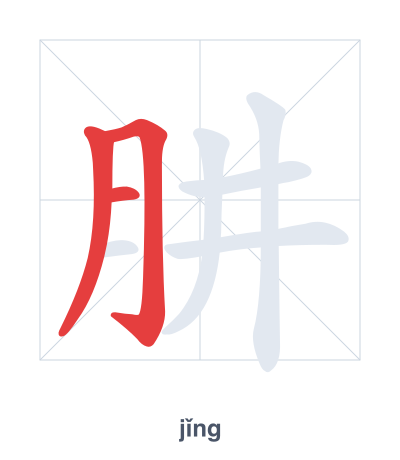
Open Hanzi Writer to see the animated stroke order and practice writing 肼 with real-time feedback.
The character 肼 (jǐng) is written with 8 strokes. Follow the standard Chinese stroke order: top to bottom, left to right, outside before inside. The radical 月 is one of its key components.
Practice the correct stroke order with the Hanzi Writer app to see animated stroke-by-stroke guidance with real-time feedback.
肼 means hydrazine.
肼 is a compound character with the radical 月 (flesh, indicating an organic compound) and the phonetic component 井 (well, providing pronunciation jǐng). This structural combination reflects its use in chemistry to denote hydrazine, an organic substance often derived from ammonia.
💡 Memory Tip: Picture a well (井) filled with glowing, toxic hydrazine fuel that looks like liquid flesh (月).
这种化合物含有肼基。
zhè zhǒng huà hé wù hán yǒu jǐng jī
This compound contains a hydrazine group.
实验室里有苯肼。
shí yàn shì lǐ yǒu běn jǐng
There is phenylhydrazine in the laboratory.
甲基肼是重要的原料。
jiǎ jī jǐng shì zhòng yào de yuán liào
Methylhydrazine is an important raw material.
Open Hanzi Writer to see the animated stroke order and practice writing 肼 with real-time feedback.
✨ Animated stroke order · Handwriting recognition · HSK-graded practice · Free to use
肼 is made of the radical 月 (meat/flesh) on the left and 井 (a well) on the right. The 月 radical often appears in characters for organic chemicals, and 井 gives the pronunciation jǐng. Together they form a phono-semantic compound meaning hydrazine, a chemical compound.