粳 (jīng) means "Japonica rice; round-grained non-glutinous rice." in Chinese. It has 13 strokes with the radical 米.
Rated 4.2/5 in difficulty (advanced).
Appears in 3+ common words including 粳米 (jīng mǐ), 粳稻 (jīng dào), 晚粳 (wǎn jīng).
Due to its 13 strokes, Hanzi Writer's error detection shows 粳 requires focused practice — most learners need 10+ attempts for consistent accuracy.
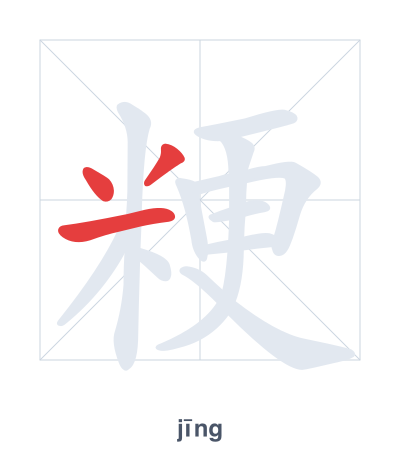
Open Hanzi Writer to see the animated stroke order and practice writing 粳 with real-time feedback.
The character 粳 (jīng) is written with 13 strokes. Follow the standard Chinese stroke order: top to bottom, left to right, outside before inside. The radical 米 is one of its key components.
Practice the correct stroke order with the Hanzi Writer app to see animated stroke-by-stroke guidance with real-time feedback.
粳 means Japonica rice; round-grained non-glutinous rice..
粳 is a phono-semantic compound: the radical 米 (rice) indicates it is a type of grain, while 更 (gèng) provides the sound and may subtly suggest a 'change' or 'different' variety—here, the round, non-glutinous Japonica rice distinct from sticky rice.
💡 Memory Tip: Picture a round-grained rice kernel (米) with a little arm (更’s top part) waving 'I'm not sticky!' at the glutinous rice.
粳米很有营养。
jīng mǐ hěn yǒu yíng yǎng
Japonica rice is very nutritious.
农民在种粳稻。
nóng mín zài zhǒng jīng dào
Farmers are planting japonica rice.
这是今年的晚粳。
zhè shì jīn nián de wǎn jīng
This is this year's late-season japonica rice.
Open Hanzi Writer to see the animated stroke order and practice writing 粳 with real-time feedback.
✨ Animated stroke order · Handwriting recognition · HSK-graded practice · Free to use
The left component is 米 (rice radical), showing that 粳 relates to rice. The right component is 更, which gives a hint to the pronunciation (jīng). Together, they specify a type of rice called japonica rice.