茧 (jiǎn) means "cocoon" in Chinese. It has 9 strokes with the radical 艹.
Rated 4/5 in difficulty (challenging).
Appears in 3+ common words including 蚕茧 (cán jiǎn), 手茧 (shǒu jiǎn), 茧子 (jiǎn zi).
Due to its 9 strokes, Hanzi Writer's error detection shows 茧 requires focused practice — most learners need 10+ attempts for consistent accuracy.
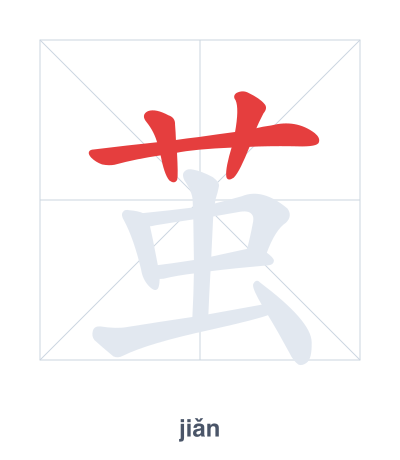
Open Hanzi Writer to see the animated stroke order and practice writing 茧 with real-time feedback.
The character 茧 (jiǎn) is written with 9 strokes. Follow the standard Chinese stroke order: top to bottom, left to right, outside before inside. The radical 艹 is one of its key components.
Practice the correct stroke order with the Hanzi Writer app to see animated stroke-by-stroke guidance with real-time feedback.
茧 means cocoon.
The character 茧 combines the radical 艹 (grass/plant) on top with a bottom component that originally depicted a silkworm wrapped in its silk casing, symbolizing a cocoon formed from plant-like fibers.
💡 Memory Tip: Picture grass (艹) growing over a tiny insect trapped inside a silk ball, like a cocoon hidden in the wild.
蚕在吐丝做茧。
cán zài tǔ sī zuò jiǎn
The silkworm is spinning silk to make a cocoon.
他的手上有厚茧。
tā de shǒu shàng yǒu hòu jiǎn
He has thick calluses on his hands.
脚上磨出了茧子。
jiǎo shàng mó chū le jiǎn zi
Calluses formed on the feet.
Open Hanzi Writer to see the animated stroke order and practice writing 茧 with real-time feedback.
✨ Animated stroke order · Handwriting recognition · HSK-graded practice · Free to use
The character 茧 has the radical 艹 (grass) on top, indicating it relates to plants or natural materials. The bottom part is 虫 (insect), which points to the silkworm or insect that produces the cocoon. Together, they suggest a grass-like structure made by an insect, which is a cocoon.