镓 (jiā) means "Gallium" in Chinese. It has 15 strokes with the radical 钅.
Rated 4.2/5 in difficulty (advanced).
Appears in 3+ common words including 镓元素 (jiā yuán sù), 镓金属 (jiā jīn shǔ), 氮化镓 (dàn huà jiā).
Due to its 15 strokes, Hanzi Writer's error detection shows 镓 requires focused practice — most learners need 10+ attempts for consistent accuracy.
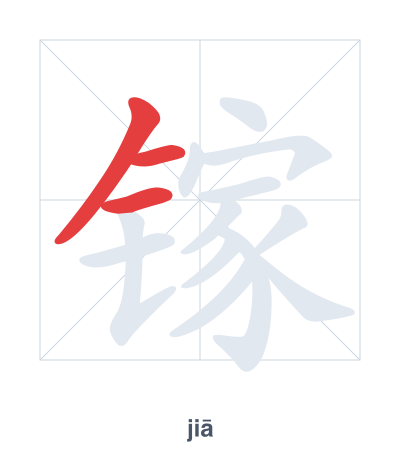
Open Hanzi Writer to see the animated stroke order and practice writing 镓 with real-time feedback.
The character 镓 (jiā) is written with 15 strokes. Follow the standard Chinese stroke order: top to bottom, left to right, outside before inside. The radical 钅 is one of its key components.
Practice the correct stroke order with the Hanzi Writer app to see animated stroke-by-stroke guidance with real-time feedback.
镓 means Gallium.
镓 is a modern compound character, combining the radical 钅 (meaning metal) with 家 (jiā, meaning family or home) as a phonetic component to approximate the pronunciation 'jiā'. This character was created to represent the element gallium (Ga), named after the Latin 'Gallia' (France), but it uses the common Chinese character 家 for its sound rather than any semantic link.
💡 Memory Tip: Picture a metal spoon (钅) that melts in a warm home (家) because gallium has a low melting point of about 30°C, easily turning to liquid.
镓元素在科技中很重要。
jiā yuán sù zài kē jì zhōng hěn zhòng yào
Gallium is very important in technology.
镓金属在手上会融化。
jiā jīn shǔ zài shǒu shàng huì róng huà
Gallium metal melts in your hand.
这个充电器用了氮化镓。
zhè ge chōng diàn qì yòng le dàn huà jiā
This charger uses Gallium Nitride (GaN).
Open Hanzi Writer to see the animated stroke order and practice writing 镓 with real-time feedback.
✨ Animated stroke order · Handwriting recognition · HSK-graded practice · Free to use
The character 镓 has two parts: the left radical 钅 (jīn, meaning 'metal') and the right component 家 (jiā, meaning 'home' or 'family'). The metal radical indicates that 镓 is a type of metal, while the right part gives the pronunciation jiā. This is a phonetic compound where the sound comes from 家, but the meaning comes from 钅.