葭 (jiā) means "reed" in Chinese. It has 12 strokes with the radical 艹.
Rated 4.2/5 in difficulty (advanced).
Appears in 3+ common words including 蒹葭 (jiān jiā), 葭草 (jiā cǎo), 葭月 (jiā yuè).
Due to its 12 strokes, Hanzi Writer's error detection shows 葭 requires focused practice — most learners need 10+ attempts for consistent accuracy.
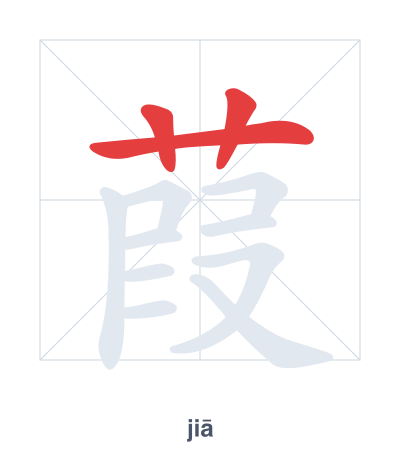
Open Hanzi Writer to see the animated stroke order and practice writing 葭 with real-time feedback.
The character 葭 (jiā) is written with 12 strokes. Follow the standard Chinese stroke order: top to bottom, left to right, outside before inside. The radical 艹 is one of its key components.
Practice the correct stroke order with the Hanzi Writer app to see animated stroke-by-stroke guidance with real-time feedback.
葭 means reed.
葭 is a phono-semantic compound: the radical 艹 indicates it is a plant, and the component 叚 (jiǎ, meaning 'false' or 'to borrow') provides the pronunciation. Ancient Chinese used 葭 to refer specifically to a type of reed that grows near water, often the young shoots of the common reed.
💡 Memory Tip: Picture a reed (艹) that 'borrows' (叚) its shape from grass but grows tall and hollow, like a straw in the marsh.
蒹葭在水边。
jiān jiā zài shuǐ biān
Reeds are by the water.
岸边长满葭草。
àn biān zhǎng mǎn jiā cǎo
The shore is covered with reeds.
葭月是十一月。
jiā yuè shì shí yī yuè
Jiayue is the eleventh month.
Open Hanzi Writer to see the animated stroke order and practice writing 葭 with real-time feedback.
✨ Animated stroke order · Handwriting recognition · HSK-graded practice · Free to use
葭 is made of two parts: the radical 艹 (grass) on top and the phonetic component 叚 (jiǎ) below. The grass radical tells you the character relates to plants, specifically reeds. The bottom part provides the sound clue, though the exact etymology is not certain.