枷 (jiā) means "cangue (ancient wooden collar for punishment)" in Chinese. It has 9 strokes with the radical 木.
Rated 4/5 in difficulty (challenging).
Appears in 3+ common words including 枷锁 (jiā suǒ), 披枷 (pī jiā), 枷号 (jiā hào).
Due to its 9 strokes, Hanzi Writer's error detection shows 枷 requires focused practice — most learners need 10+ attempts for consistent accuracy.
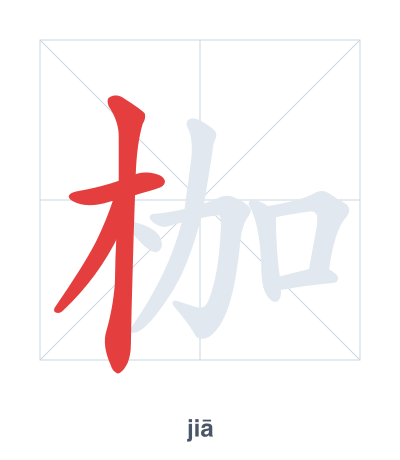
Open Hanzi Writer to see the animated stroke order and practice writing 枷 with real-time feedback.
The character 枷 (jiā) is written with 9 strokes. Follow the standard Chinese stroke order: top to bottom, left to right, outside before inside. The radical 木 is one of its key components.
Practice the correct stroke order with the Hanzi Writer app to see animated stroke-by-stroke guidance with real-time feedback.
枷 means cangue (ancient wooden collar for punishment).
枷 is a compound character with the radical 木 (wood) indicating the material it's made of, and 加 (jiā, meaning 'to add' or 'to press') serving as a phonetic and semantic component—suggesting a wooden device that is 'added' or 'applied' to a prisoner's neck as punishment. The cangue was a heavy wooden collar locked around the neck to restrain and shame criminals.
💡 Memory Tip: Imagine a wooden tree branch (木) pressing down hard on someone's neck, with the twisted shape of 加 looking like the locking mechanism that 'adds' the weight of punishment.
他打破了旧的枷锁。
tā dǎ pò le jiù de jiā suǒ
He broke the old chains.
古代犯人要披枷。
gǔ dài fàn rén yào pī jiā
Ancient prisoners had to wear a cangue (wooden stock).
枷号是古代的刑罚。
jiā hào shì gǔ dài de xíng fá
Wearing a cangue was an ancient form of punishment.
Open Hanzi Writer to see the animated stroke order and practice writing 枷 with real-time feedback.
✨ Animated stroke order · Handwriting recognition · HSK-graded practice · Free to use
The character 枷 is made of two parts: the radical 木 (wood) on the left, and 加 (jiā, 'to add') on the right. The 木 suggests that a cangue is made of wood, and 加 hints at the sound jiā as well as the idea of 'adding' a heavy collar around a prisoner's neck.