鲫 (jì) means "Crucian carp" in Chinese. It has 15 strokes with the radical 鱼.
Rated 4.2/5 in difficulty (advanced).
Appears in 3+ common words including 鲫鱼 (jì yú), 鲫鱼汤 (jì yú tāng), 红烧鲫鱼 (hóng shāo jì yú).
Due to its 15 strokes, Hanzi Writer's error detection shows 鲫 requires focused practice — most learners need 10+ attempts for consistent accuracy.
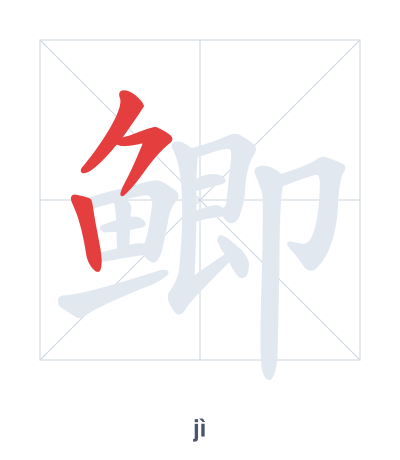
Open Hanzi Writer to see the animated stroke order and practice writing 鲫 with real-time feedback.
The character 鲫 (jì) is written with 15 strokes. Follow the standard Chinese stroke order: top to bottom, left to right, outside before inside. The radical 鱼 is one of its key components.
Practice the correct stroke order with the Hanzi Writer app to see animated stroke-by-stroke guidance with real-time feedback.
鲫 means Crucian carp.
鲫 is a phono-semantic compound combining the radical 鱼 (fish) with 即 (jí), which provides the pronunciation and hints at the fish's behavior: crucian carp are known for approaching shallow waters to feed, aligning with 即's meaning 'to approach'.
💡 Memory Tip: A fish (鱼) that immediately (即) darts away when you try to catch it—that's the quick crucian carp.
鲫鱼在南方很常见。
jì yú zài nán fāng hěn cháng jiàn
Crucian carp is very common in the south.
妈妈今天做了鲫鱼汤。
mā mā jīn tiān zuò le jì yú tāng
Mom made crucian carp soup today.
我最喜欢吃红烧鲫鱼。
wǒ zuì xǐ huān chī hóng shāo jì yú
I like eating braised crucian carp the most.
Open Hanzi Writer to see the animated stroke order and practice writing 鲫 with real-time feedback.
✨ Animated stroke order · Handwriting recognition · HSK-graded practice · Free to use
The left side is the radical 鱼 (fish), which indicates the character relates to fish. The right side is 即 (jì), which provides the pronunciation and acts as a phonetic component. Together, they form the character for crucian carp, a specific type of fish.