蒺 (jí) means "Puncture vine or gorse" in Chinese. It has 13 strokes with the radical 艹.
Rated 4.2/5 in difficulty (advanced).
Appears in 3+ common words including 蒺藜 (jí lí), 铁蒺藜 (tiě jí lí), 蒺藜子 (jí lí zi).
Due to its 13 strokes, Hanzi Writer's error detection shows 蒺 requires focused practice — most learners need 10+ attempts for consistent accuracy.
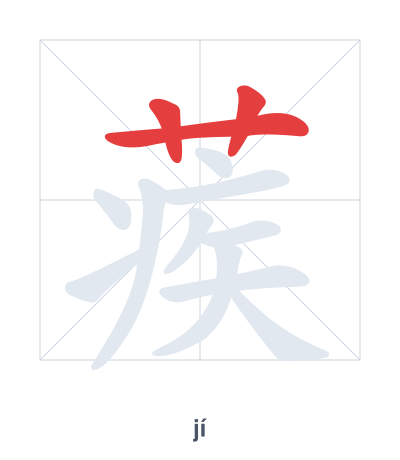
Open Hanzi Writer to see the animated stroke order and practice writing 蒺 with real-time feedback.
The character 蒺 (jí) is written with 13 strokes. Follow the standard Chinese stroke order: top to bottom, left to right, outside before inside. The radical 艹 is one of its key components.
Practice the correct stroke order with the Hanzi Writer app to see animated stroke-by-stroke guidance with real-time feedback.
蒺 means Puncture vine or gorse.
蒺 is a phono-semantic compound: the radical 艹 (grass) indicates it is a plant, while the phonetic component 疾 (jí, meaning 'disease' or 'pain') hints at the painful, prickly nature of puncture vine, as its thorns cause injury like a sickness.
💡 Memory Tip: Imagine stepping on a patch of grass (艹) and a sharp arrow (矢 inside 疾) shoots up, giving you a painful 'disease' (疾).
这种植物叫蒺藜。
zhè zhòng zhí wù jiào jí lí
This plant is called puncturevine.
墙上有铁蒺藜。
qiáng shàng yǒu tiě jí lí
There is barbed wire on the wall.
小心地上的蒺藜子。
xiǎo xīn dì shàng de jí lí zi
Watch out for the puncture vines on the ground.
Open Hanzi Writer to see the animated stroke order and practice writing 蒺 with real-time feedback.
✨ Animated stroke order · Handwriting recognition · HSK-graded practice · Free to use
蒺 is composed of the grass radical 艹 on top and the phonetic component 疾 (jí, meaning sickness or speed) below. The 艹 indicates it is a plant, while 疾 hints at the pronunciation jí and the spiny, troublesome nature of the puncture vine.