藜 (lí) means "goosefoot; chenopodium" in Chinese. It has 18 strokes with the radical 艹.
Rated 4.2/5 in difficulty (advanced).
Appears in 3+ common words including 藜麦 (lí mài), 藜科 (lí kē), 藜杖 (lí zhàng).
Due to its 18 strokes, Hanzi Writer's error detection shows 藜 requires focused practice — most learners need 10+ attempts for consistent accuracy.
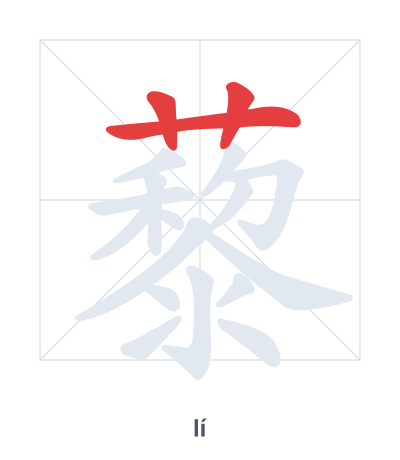
Open Hanzi Writer to see the animated stroke order and practice writing 藜 with real-time feedback.
The character 藜 (lí) is written with 18 strokes. Follow the standard Chinese stroke order: top to bottom, left to right, outside before inside. The radical 艹 is one of its key components.
Practice the correct stroke order with the Hanzi Writer app to see animated stroke-by-stroke guidance with real-time feedback.
藜 means goosefoot; chenopodium.
藜 is a phonetic compound: the grass radical 艹 indicates it is a plant, while the lower part 黎 (lí, meaning 'black') provides pronunciation and may hint at the dark color of the goosefoot's leaves or stems.
💡 Memory Tip: Picture a goosefoot weed (艹) sprouting in a grain field (禾) where a person (人) pours water (氺), mistaking the weed for a crop.
藜麦很有营养。
lí mài hěn yǒu yíng yǎng
Quinoa is very nutritious.
藜麦属于藜科。
lí mài shǔ yú lí kē
Quinoa belongs to the goosefoot family.
他拄着一根藜杖。
tā zhǔ zhe yī gēn lí zhàng
He was leaning on a goosefoot staff.
Open Hanzi Writer to see the animated stroke order and practice writing 藜 with real-time feedback.
✨ Animated stroke order · Handwriting recognition · HSK-graded practice · Free to use
藜 is composed of the radical 艹 (grass) on top, indicating it is a plant, and the phonetic component 黎 (lí) below, which gives a clue to its pronunciation. The plant is a type of goosefoot, a common weed or edible plant.