汲 (jí) means "To draw (water) / to derive" in Chinese. It has 6 strokes with the radical 氵.
Rated 3.2/5 in difficulty (challenging).
Appears in 3+ common words including 汲取 (jí qǔ), 汲水 (jí shuǐ), 汲引 (jí yǐn).
Due to its 6 strokes, Hanzi Writer's error detection shows 汲 requires focused practice — most learners need 10+ attempts for consistent accuracy.
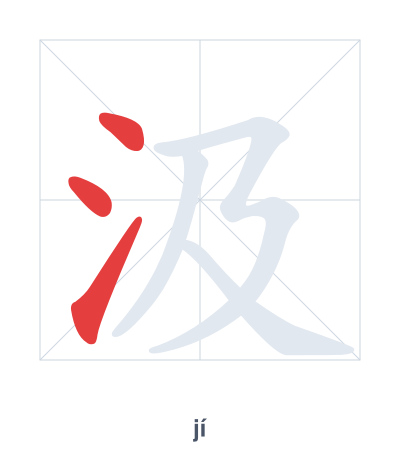
Open Hanzi Writer to see the animated stroke order and practice writing 汲 with real-time feedback.
The character 汲 (jí) is written with 6 strokes. Follow the standard Chinese stroke order: top to bottom, left to right, outside before inside. The radical 氵 is one of its key components.
Practice the correct stroke order with the Hanzi Writer app to see animated stroke-by-stroke guidance with real-time feedback.
汲 means To draw (water) / to derive.
汲 is a compound character with the radical 氵 (water) on the left and 及 (jí, 'to reach') on the right. 及 originally depicted a hand (又) reaching out to catch a person (人), so together 汲 suggests reaching into water to draw it up.
💡 Memory Tip: Picture a hand (又) dipping into water (氵) to grab a person (人) who fell in, drawing them to safety.
我们要汲取知识。
wǒ men yào jí qǔ zhī shí
We should absorb knowledge.
农民在井边汲水。
nóng mín zài jǐng biān jí shuǐ
The farmer is drawing water from the well.
这本书汲引了很多观点。
zhè běn shū jí yǐn le hěn duō guān diǎn
This book draws on many viewpoints.
Open Hanzi Writer to see the animated stroke order and practice writing 汲 with real-time feedback.
✨ Animated stroke order · Handwriting recognition · HSK-graded practice · Free to use
汲 is made of the water radical 氵 on the left and the character 及 (jí, meaning 'to reach') on the right. Together, 'water reaching out' suggests the action of drawing or scooping water, which is the original meaning. This structure also extends to abstract meanings like 'to derive' or 'to absorb' ideas.