楫 (jí) means "oar; paddle" in Chinese. It has 13 strokes with the radical 木.
Rated 4.2/5 in difficulty (advanced).
Appears in 3+ common words including 舟楫 (zhōu jí), 划楫 (huà jí), 楫子 (jí zi).
Due to its 13 strokes, Hanzi Writer's error detection shows 楫 requires focused practice — most learners need 10+ attempts for consistent accuracy.
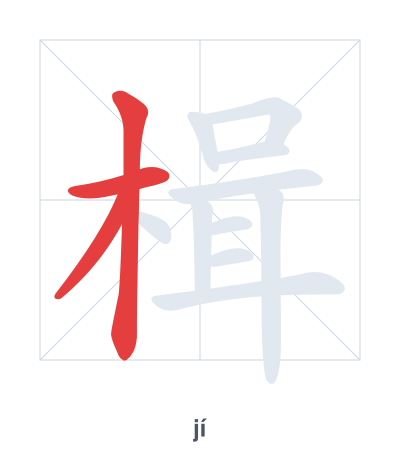
Open Hanzi Writer to see the animated stroke order and practice writing 楫 with real-time feedback.
The character 楫 (jí) is written with 13 strokes. Follow the standard Chinese stroke order: top to bottom, left to right, outside before inside. The radical 木 is one of its key components.
Practice the correct stroke order with the Hanzi Writer app to see animated stroke-by-stroke guidance with real-time feedback.
楫 means oar; paddle.
楫 is a phono-semantic compound: the radical 木 (wood) indicates the oar's material, while 咠 (jí) provides the pronunciation and visually resembles a hand gripping a wooden shaft, suggesting the action of rowing.
💡 Memory Tip: Imagine a wooden (木) oar with a mouth (口) and ear (耳) carved on it, silently whispering the rhythm for each stroke.
河上有许多舟楫。
hé shàng yǒu xǔ duō zhōu jí
There are many boats and vessels on the river.
他们正在用力划楫。
tā men zhèng zài yòng lì huà jí
They are rowing hard.
船夫拿起了楫子。
chuán fū ná qǐ le jí zi
The boatman picked up the oar.
Open Hanzi Writer to see the animated stroke order and practice writing 楫 with real-time feedback.
✨ Animated stroke order · Handwriting recognition · HSK-graded practice · Free to use
The character 楫 is made of the radical 木 (wood) on the left and the phonetic component 咠 (jí) on the right. The wood radical shows it is an object made of wood, while 咠 gives the sound, together creating the meaning 'oar' or 'paddle'.