藿 (huò) means "agastache / patchouli" in Chinese. It has 19 strokes with the radical 艹.
Rated 4.2/5 in difficulty (advanced).
Appears in 3+ common words including 藿香 (huò xiāng), 藿香正气水 (huò xiāng zhèng qì shuǐ), 豆藿 (dòu huò).
Due to its 19 strokes, Hanzi Writer's error detection shows 藿 requires focused practice — most learners need 10+ attempts for consistent accuracy.
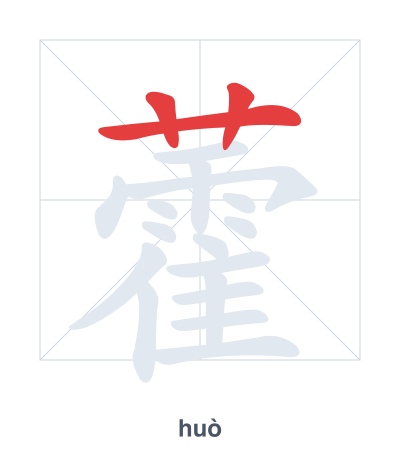
Open Hanzi Writer to see the animated stroke order and practice writing 藿 with real-time feedback.
The character 藿 (huò) is written with 19 strokes. Follow the standard Chinese stroke order: top to bottom, left to right, outside before inside. The radical 艹 is one of its key components.
Practice the correct stroke order with the Hanzi Writer app to see animated stroke-by-stroke guidance with real-time feedback.
藿 means agastache / patchouli.
藿 is a phono-semantic compound: the radical 艹 (grass) indicates it's a plant, while 霍 provides the pronunciation huò. The character originally referred to a type of aromatic herb, specifically agastache or patchouli, used in traditional medicine and cuisine.
💡 Memory Tip: Picture a patchouli plant (艹) that suddenly (霍) bursts with a powerful, memorable scent when you brush its leaves.
藿香是一种中药。
huò xiāng shì yī zhǒng zhōng yào
Agastache is a type of Chinese herbal medicine.
他喝了一瓶藿香正气水。
tā hē le yī píng huò xiāng zhèng qì shuǐ
He drank a bottle of Huoxiang Zhengqi liquid.
农民在收豆藿。
nóng mín zài shōu dòu huò
Farmers are harvesting bean leaves.
Open Hanzi Writer to see the animated stroke order and practice writing 藿 with real-time feedback.
✨ Animated stroke order · Handwriting recognition · HSK-graded practice · Free to use
藿 is a phono-semantic compound. The radical 艹 (grass) on top indicates it is related to plants or herbs. The bottom part 霍 (huò) provides the pronunciation and also hints at the idea of "sudden" or "abundant" growth, which fits the image of aromatic herbs like patchouli.