惛 (hūn) means "confused; muddled" in Chinese. It has 11 strokes with the radical 忄.
Rated 4.2/5 in difficulty (advanced).
Appears in 3+ common words including 惛乱 (hūn luàn), 惛惛 (hūn hūn), 惛懵 (hūn měng).
Due to its 11 strokes, Hanzi Writer's error detection shows 惛 requires focused practice — most learners need 10+ attempts for consistent accuracy.
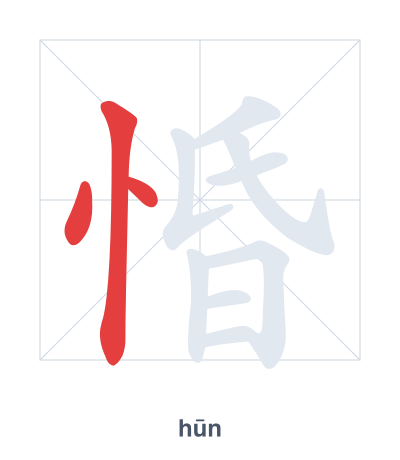
Open Hanzi Writer to see the animated stroke order and practice writing 惛 with real-time feedback.
The character 惛 (hūn) is written with 11 strokes. Follow the standard Chinese stroke order: top to bottom, left to right, outside before inside. The radical 忄 is one of its key components.
Practice the correct stroke order with the Hanzi Writer app to see animated stroke-by-stroke guidance with real-time feedback.
惛 means confused; muddled.
This compound character combines the heart radical 忄 (xīn) with 昏 (hūn), meaning 'dusk' or 'darkness'. The heart being in darkness suggests a state of mental obscurity, hence being confused or muddled.
💡 Memory Tip: Picture a heart (忄) enveloped in the deep darkness of dusk (昏) — you can't see clearly, so your thoughts become completely muddled.
他的思绪很惛乱。
tā de sī xù hěn hūn luàn
His thoughts are confused and muddled.
他整天惛惛欲睡。
tā zhěng tiān hūn hūn yù shuì
He is drowsy and sleepy all day long.
他的意识有些惛懵。
tā de yì shí yǒu xiē hūn měng
His consciousness is somewhat muddled.
Open Hanzi Writer to see the animated stroke order and practice writing 惛 with real-time feedback.
✨ Animated stroke order · Handwriting recognition · HSK-graded practice · Free to use
惛 is composed of the heart radical 忄 on the left and the phonetic component 昏 on the right. The heart radical suggests emotion or mental state, and 昏 itself means 'dusk' or 'dim,' so together they convey a heart or mind that is dim and unclear—hence 'confused' or 'muddled.'