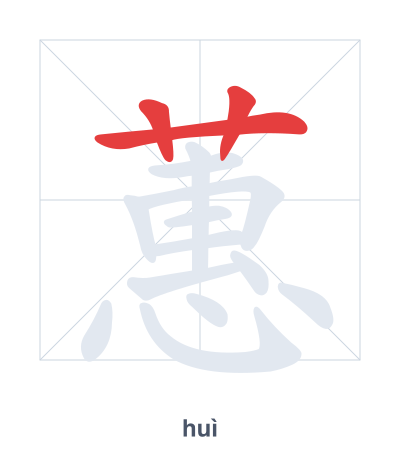
蕙 (huì) means "Cymbidium orchid" in Chinese. It has 15 strokes with the radical 艹.
Rated 4.2/5 in difficulty (advanced).
Appears in 3+ common words including 蕙兰 (huì lán), 蕙心 (huì xīn), 香蕙 (xiāng huì).
Due to its 15 strokes, Hanzi Writer's error detection shows 蕙 requires focused practice — most learners need 10+ attempts for consistent accuracy.
Open Hanzi Writer to see the animated stroke order and practice writing 蕙 with real-time feedback.
The character 蕙 (huì) is written with 15 strokes. Follow the standard Chinese stroke order: top to bottom, left to right, outside before inside. The radical 艹 is one of its key components.
Practice the correct stroke order with the Hanzi Writer app to see animated stroke-by-stroke guidance with real-time feedback.
蕙 means Cymbidium orchid.
蕙 is a phono-semantic compound: the radical 艹 (grass) indicates it is a plant, specifically an orchid. The phonetic component 惠 (huì, meaning 'kindness' or 'benefit') provides the sound and may subtly suggest the orchid's fragrant, gentle nature.
💡 Memory Tip: Picture a kind-hearted ghost (惠 = 叀 + 心) hiding under a grass canopy (艹), emitting a sweet orchid scent that soothes all who pass.
我家有一盆蕙兰。
wǒ jiā yǒu yī pén huì lán
My home has a pot of cymbidium.
她是一个蕙心的女孩。
tā shì yí gè huì xīn de nǚ hái
She is a pure and intelligent girl.
香蕙的味道很好闻。
xiāng huì de wèi dào hěn hǎo wén
The fragrance of the orchid is very pleasant.
Open Hanzi Writer to see the animated stroke order and practice writing 蕙 with real-time feedback.
✨ Animated stroke order · Handwriting recognition · HSK-graded practice · Free to use
蕙 has the grass radical 艹 on top, indicating a plant or herb. The bottom part is 惠, which provides the sound and also carries the meaning of kindness or benefit, so together 蕙 suggests a fragrant, benevolent orchid.