璜 (huáng) means "Semi-circular jade pendant" in Chinese. It has 15 strokes with the radical 王.
Rated 4.2/5 in difficulty (advanced).
Appears in 3+ common words including 玉璜 (yù huáng), 璜溪 (huáng xī), 璜台 (huáng tái).
Due to its 15 strokes, Hanzi Writer's error detection shows 璜 requires focused practice — most learners need 10+ attempts for consistent accuracy.
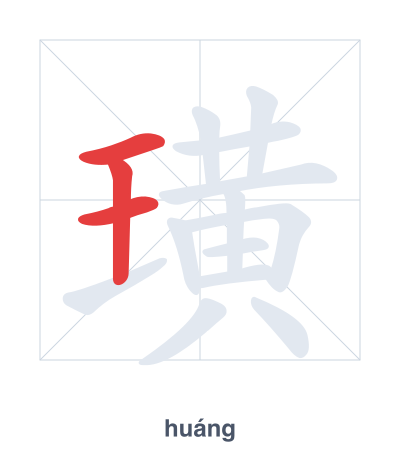
Open Hanzi Writer to see the animated stroke order and practice writing 璜 with real-time feedback.
The character 璜 (huáng) is written with 15 strokes. Follow the standard Chinese stroke order: top to bottom, left to right, outside before inside. The radical 王 is one of its key components.
Practice the correct stroke order with the Hanzi Writer app to see animated stroke-by-stroke guidance with real-time feedback.
璜 means Semi-circular jade pendant.
The character 璜 combines the jade radical 王 (玉) with the phonetic component 黄 (huáng, meaning 'yellow'), indicating both the material (jade) and the color of the ancient semi-circular pendant often carved from yellow jade. This type of pendant was a ritual object in Zhou dynasty ceremonies, symbolizing heaven when paired with a round bi disk.
💡 Memory Tip: Picture a king (王) wearing a bright yellow (黄) half-circle jade pendant on his chest, gleaming in the sunlight.
这个玉璜是半圆形的。
zhè ge yù huáng shì bàn yuán xíng de
This jade pendant is semi-circular.
璜溪的水非常清澈。
huáng xī de shuǐ fēi cháng qīng chè
The water in Huangxi is very clear.
他登上了那座璜台。
tā dēng shàng le nà zuò huáng tái
He climbed up that jade terrace.
Open Hanzi Writer to see the animated stroke order and practice writing 璜 with real-time feedback.
✨ Animated stroke order · Handwriting recognition · HSK-graded practice · Free to use
璜 is made of the radical 王 (jade) on the left and 黄 (huáng, yellow) on the right. The radical tells you it is a type of jade object, while 黄 gives the pronunciation. Together they describe a semi-circular jade pendant often used in ancient rituals.