鲩 (huàn) means "Grass carp" in Chinese. It has 15 strokes with the radical 鱼.
Rated 4.2/5 in difficulty (advanced).
Appears in 3+ common words including 鲩鱼 (huàn yú), 养鲩鱼 (yǎng huàn yú), 鲜鲩鱼 (xiān huàn yú).
Due to its 15 strokes, Hanzi Writer's error detection shows 鲩 requires focused practice — most learners need 10+ attempts for consistent accuracy.
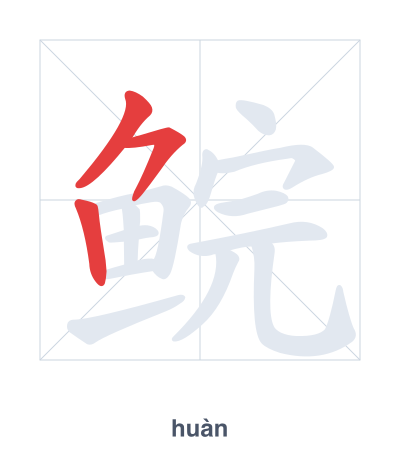
Open Hanzi Writer to see the animated stroke order and practice writing 鲩 with real-time feedback.
The character 鲩 (huàn) is written with 15 strokes. Follow the standard Chinese stroke order: top to bottom, left to right, outside before inside. The radical 鱼 is one of its key components.
Practice the correct stroke order with the Hanzi Writer app to see animated stroke-by-stroke guidance with real-time feedback.
鲩 means Grass carp.
鲩 is a phono-semantic compound combining the radical 鱼 (fish) with 完 (wán) as a phonetic component. The 鱼 radical indicates this character refers to a type of fish, while 完 provides the pronunciation huàn. Grass carp is a common freshwater fish in East Asia.
💡 Memory Tip: Picture a fish (鱼) that has completely (完) devoured an entire grassy bank, leaving it perfectly full.
鲩鱼也叫作草鱼。
huàn yú yě jiào zuò cǎo yú
Grass carp is also called grass carp.
爷爷在池塘里养鲩鱼。
yé yé zài chí táng lǐ yǎng huàn yú
Grandpa is raising grass carp in the pond.
这里的鲜鲩鱼很便宜。
zhè lǐ de xiān huàn yú hěn pián yi
The fresh grass carp here is very cheap.
Open Hanzi Writer to see the animated stroke order and practice writing 鲩 with real-time feedback.
✨ Animated stroke order · Handwriting recognition · HSK-graded practice · Free to use
The left side 鱼 (fish) is the radical, indicating the character relates to fish. The right side 完 (wán) provides the sound huàn and originally meant "complete" or "whole," perhaps suggesting a full-grown fish. Together, 鲩 refers to the grass carp, a common freshwater fish.