獾 (huān) means "Badger" in Chinese. It has 20 strokes with the radical 犭.
Rated 3.8/5 in difficulty (challenging).
Appears in 3+ common words including 獾子 (huān zi), 猪獾 (zhū huān), 獾皮 (huān pí).
Due to its 20 strokes, Hanzi Writer's error detection shows 獾 requires focused practice — most learners need 10+ attempts for consistent accuracy.
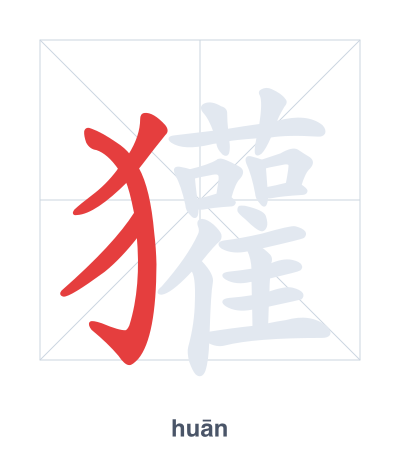
Open Hanzi Writer to see the animated stroke order and practice writing 獾 with real-time feedback.
The character 獾 (huān) is written with 20 strokes. Follow the standard Chinese stroke order: top to bottom, left to right, outside before inside. The radical 犭 is one of its key components.
Practice the correct stroke order with the Hanzi Writer app to see animated stroke-by-stroke guidance with real-time feedback.
獾 means Badger.
獾 is a phono-semantic compound: the radical 犭 (dog/animal) signals it's a wild animal, while the right side 雚 (originally a heron-like bird but here purely phonetic) suggests the sound huān. Together they represent the badger, a burrowing mammal.
💡 Memory Tip: Picture a badger (犭) with two big round eyes and a wide mouth (雚) peeking out of its den, whistling a tune like 'whoa-an'.
山里有一只獾子。
shān lǐ yǒu yī zhī huān zi
There is a badger in the mountains.
猪獾喜欢住在洞里。
zhū huān xǐ huān zhù zài dòng lǐ
Hog badgers like to live in burrows.
獾皮可以做帽子。
huān pí kě yǐ zuò mào zi
Badger fur can be used to make hats.
Open Hanzi Writer to see the animated stroke order and practice writing 獾 with real-time feedback.
✨ Animated stroke order · Handwriting recognition · HSK-graded practice · Free to use
The left radical 犭 indicates the character relates to animals or beasts, showing that 獾 is a type of animal. The right part 雚 (guàn) provides the sound but does not carry meaning, so the structure is a semantic-phonetic compound where the radical gives the meaning and the right side hints at the pronunciation (huān).