琥 (hǔ) means "Amber (component of 琥珀)" in Chinese. It has 12 strokes with the radical 王.
Rated 4.2/5 in difficulty (advanced).
Appears in 3+ common words including 琥珀 (hǔ pò), 琥珀色 (hǔ pò sè), 琥珀项链 (hǔ pò xiàng liàn).
Due to its 12 strokes, Hanzi Writer's error detection shows 琥 requires focused practice — most learners need 10+ attempts for consistent accuracy.
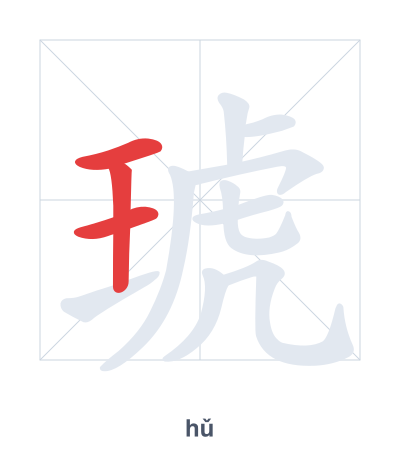
Open Hanzi Writer to see the animated stroke order and practice writing 琥 with real-time feedback.
The character 琥 (hǔ) is written with 12 strokes. Follow the standard Chinese stroke order: top to bottom, left to right, outside before inside. The radical 王 is one of its key components.
Practice the correct stroke order with the Hanzi Writer app to see animated stroke-by-stroke guidance with real-time feedback.
琥 means Amber (component of 琥珀).
The character 琥 combines the jade radical (王), indicating a precious stone, with the phonetic component 虎 (tiger), which provides the pronunciation hǔ. In ancient Chinese culture, amber was sometimes associated with the tiger's essence or color, as seen in the compound 琥珀 (amber).
💡 Memory Tip: Picture a tiger (虎) carved from glowing jade (王) that shines like amber.
琥珀里有一只小虫。
hǔ pò lǐ yǒu yī zhī xiǎo chóng
There is a small insect in the amber.
天空变成了琥珀色。
tiān kōng biàn chéng le hǔ pò sè
The sky turned amber.
她戴着琥珀项链。
tā dài zhe hǔ pò xiàng liàn
She is wearing an amber necklace.
Open Hanzi Writer to see the animated stroke order and practice writing 琥 with real-time feedback.
✨ Animated stroke order · Handwriting recognition · HSK-graded practice · Free to use
琥 is composed of the radical 王 (jade) on the left and 虎 (tiger) on the right. The jade radical indicates that 琥 relates to precious stones, while 虎 provides pronunciation and also hints at the tiger-like golden color of amber.