焢 (hōng) means "to simmer or stew" in Chinese. It has 12 strokes with the radical 火.
Rated 4.2/5 in difficulty (advanced).
Appears in 3+ common words including 焢肉 (hōng ròu), 焢肉饭 (hōng ròu fàn), 焢窑 (hōng yáo).
Due to its 12 strokes, Hanzi Writer's error detection shows 焢 requires focused practice — most learners need 10+ attempts for consistent accuracy.
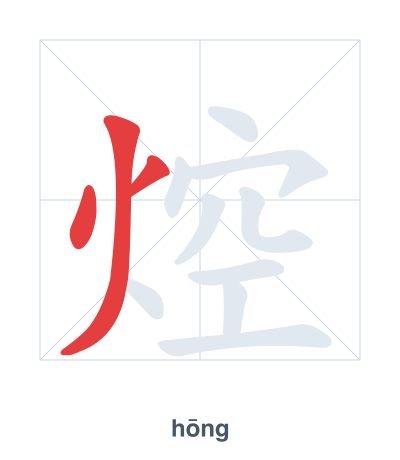
Open Hanzi Writer to see the animated stroke order and practice writing 焢 with real-time feedback.
The character 焢 (hōng) is written with 12 strokes. Follow the standard Chinese stroke order: top to bottom, left to right, outside before inside. The radical 火 is one of its key components.
Practice the correct stroke order with the Hanzi Writer app to see animated stroke-by-stroke guidance with real-time feedback.
焢 means to simmer or stew.
焢 is a compound character with the fire radical 火 indicating heat, and 空 ('empty' or 'sky') as a phonetic component, though the pronunciation shifted from kōng to hōng. The combination suggests cooking with gentle heat, allowing steam and air to circulate, which is essential for simmering or stewing.
💡 Memory Tip: Picture a pot on fire (火) with an empty (空) space above—just the right environment for a slow simmering stew.
我想吃焢肉。
wǒ xiǎng chī hōng ròu
I want to eat braised pork.
这家焢肉饭很出名。
zhè jiā hōng ròu fàn hěn chū míng
This braised pork rice place is very famous.
我们去郊外焢窑。
wǒ men qù jiāo wài hōng yáo
We are going to the countryside for an earth oven barbecue.
Open Hanzi Writer to see the animated stroke order and practice writing 焢 with real-time feedback.
✨ Animated stroke order · Handwriting recognition · HSK-graded practice · Free to use
焢 is composed of the fire radical 火 on the left and 宏 (hóng) on the right. The fire radical indicates heat is involved, while 宏 provides the sound and suggests a large or thorough cooking process, which matches the meaning of simmering or stewing slowly.