皓 (hào) means "Bright; white" in Chinese. It has 12 strokes with the radical 白.
Rated 4.2/5 in difficulty (advanced).
Appears in 3+ common words including 皓月 (hào yuè), 皓白 (hào bái), 皓齿 (hào chǐ).
Due to its 12 strokes, Hanzi Writer's error detection shows 皓 requires focused practice — most learners need 10+ attempts for consistent accuracy.
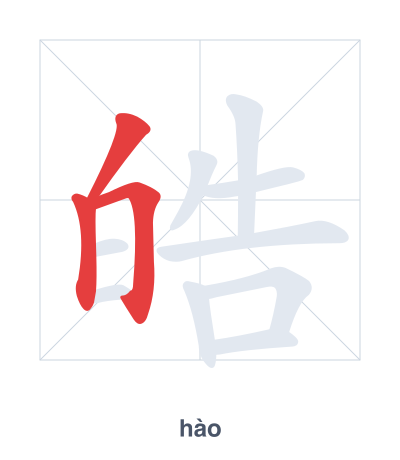
Open Hanzi Writer to see the animated stroke order and practice writing 皓 with real-time feedback.
The character 皓 (hào) is written with 12 strokes. Follow the standard Chinese stroke order: top to bottom, left to right, outside before inside. The radical 白 is one of its key components.
Practice the correct stroke order with the Hanzi Writer app to see animated stroke-by-stroke guidance with real-time feedback.
皓 means Bright; white.
| Character | 皓 |
| Pinyin | hào (hao) |
| Meaning | Bright; white |
| Strokes | 12 |
| Radical | 白 |
| Difficulty | 4.2/5 |
皓 combines the radical 白 (white, brightness) with 告 (gào, 'to announce' as a phonetic component). The character literally means 'bright white,' like the radiant glow of the moon or a clear dawn sky.
💡 Memory Tip: Picture the bright white full moon (白) loudly announcing (告) its brilliance across the night sky.
皓月当空。
hào yuè dāng kōng
The bright moon shines in the sky.
头发已经皓白。
tóu fà yǐ jīng hào bái
The hair has already turned snowy white.
她有明眸皓齿。
tā yǒu míng móu hào chǐ
She has bright eyes and white teeth.
Open Hanzi Writer to see the animated stroke order and practice writing 皓 with real-time feedback.
✨ Animated stroke order · Handwriting recognition · HSK-graded practice · Free to use
皓 is composed of the radical 白 (white) on the left and the component 皋 on the right. The left part 白 directly contributes the idea of whiteness or brightness, while 皋 originally meant "high" or "bright" in ancient texts, reinforcing the overall meaning of a bright, pure white.