蚶 (hān) means "Blood clam / Cockle" in Chinese. It has 11 strokes with the radical 虫.
Rated 4.2/5 in difficulty (advanced).
Appears in 3+ common words including 蚶子 (hān zi), 血蚶 (xuè hān), 蚶肉 (hān ròu).
Due to its 11 strokes, Hanzi Writer's error detection shows 蚶 requires focused practice — most learners need 10+ attempts for consistent accuracy.
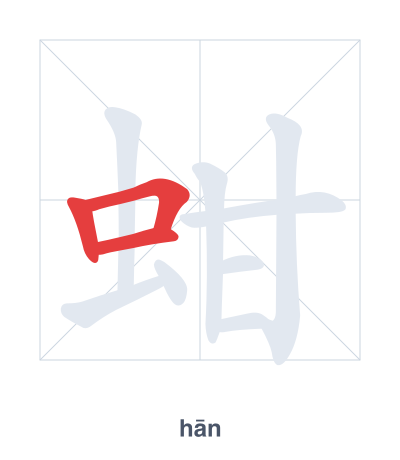
Open Hanzi Writer to see the animated stroke order and practice writing 蚶 with real-time feedback.
The character 蚶 (hān) is written with 11 strokes. Follow the standard Chinese stroke order: top to bottom, left to right, outside before inside. The radical 虫 is one of its key components.
Practice the correct stroke order with the Hanzi Writer app to see animated stroke-by-stroke guidance with real-time feedback.
蚶 means Blood clam / Cockle.
蚶 is a phono-semantic compound: the radical 虫 indicates it is a creature (shellfish), while 甘 (gān, 'sweet') provides the sound and hints at the clam's sweet taste. The ancient form of 甘 depicted a mouth enjoying sweetness, so together the character suggests a tasty sea creature.
💡 Memory Tip: A blood clam (虫) so sweet (甘) that when you slurp it, you exclaim 'Hān!'
这种蚶子很好吃。
zhè zhǒng hān zi hěn hǎo chī
This cockle is delicious.
他最喜欢吃血蚶。
tā zuì xǐ huān chī xuè hān
He likes eating blood clams the most.
蚶肉可以用来炒菜。
hān ròu kě yǐ yòng lái chǎo cài
Clam meat can be used for stir-frying.
Open Hanzi Writer to see the animated stroke order and practice writing 蚶 with real-time feedback.
✨ Animated stroke order · Handwriting recognition · HSK-graded practice · Free to use
The left part 虫 is the radical for insects or small creatures, and it tells us 蚶 is a type of shellfish. The right part 甘 (meaning sweet) gives a clue to the pronunciation, though the tones are different. Together, they form a character for a specific clam.