胲 (hǎi) means "hydroxylamine" in Chinese. It has 10 strokes with the radical 月.
Rated 4.2/5 in difficulty (advanced).
Appears in 3+ common words including 胲 (hǎi), 胲基 (hǎi jī), 胲类 (hǎi lèi).
Due to its 10 strokes, Hanzi Writer's error detection shows 胲 requires focused practice — most learners need 10+ attempts for consistent accuracy.
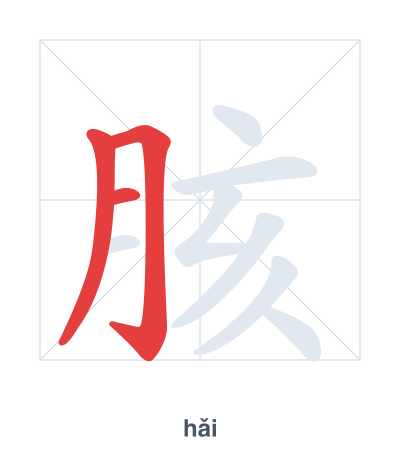
Open Hanzi Writer to see the animated stroke order and practice writing 胲 with real-time feedback.
The character 胲 (hǎi) is written with 10 strokes. Follow the standard Chinese stroke order: top to bottom, left to right, outside before inside. The radical 月 is one of its key components.
Practice the correct stroke order with the Hanzi Writer app to see animated stroke-by-stroke guidance with real-time feedback.
胲 means hydroxylamine.
胲 is a phono-semantic compound: the radical 月 (flesh/meat) hints at bodily tissue or chemical substances, while 亥 (hài) provides the pronunciation. Originally referring to the flesh of the cheek, it was later repurposed in modern chemistry to denote hydroxylamine.
💡 Memory Tip: Picture a pig (亥) with a swollen cheek (月) that a chemist injects with hydroxylamine to preserve its meat.
胲是一个化学名词。
hǎi shì yí gè huà xué míng cí
'Hai' is a chemical term (hydroxylamine).
这是一个胲基。
zhè shì yí gè hǎi jī
This is a hydroxylamino group.
胲类化合物很有用。
hǎi lèi huà hé wù hěn yǒu yòng
Hydroxylamine compounds are very useful.
Open Hanzi Writer to see the animated stroke order and practice writing 胲 with real-time feedback.
✨ Animated stroke order · Handwriting recognition · HSK-graded practice · Free to use
胲 is composed of the radical 月 (meaning 'moon' or 'flesh') on the left and the phonetic component 亥 (hài) on the right. The radical 月 often relates to body parts or chemical terms, while 亥 provides the sound. Together they form a character used in chemistry for 'hydroxylamine.'