椁 (guǒ) means "Outer coffin" in Chinese. It has 12 strokes with the radical 木.
Rated 4.2/5 in difficulty (advanced).
Appears in 3+ common words including 棺椁 (guān guǒ), 外椁 (wài guǒ), 木椁 (mù guǒ).
Due to its 12 strokes, Hanzi Writer's error detection shows 椁 requires focused practice — most learners need 10+ attempts for consistent accuracy.
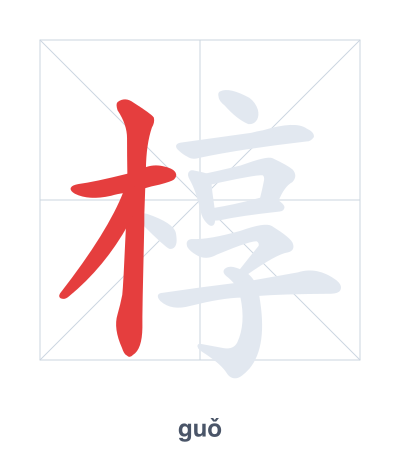
Open Hanzi Writer to see the animated stroke order and practice writing 椁 with real-time feedback.
The character 椁 (guǒ) is written with 12 strokes. Follow the standard Chinese stroke order: top to bottom, left to right, outside before inside. The radical 木 is one of its key components.
Practice the correct stroke order with the Hanzi Writer app to see animated stroke-by-stroke guidance with real-time feedback.
椁 means Outer coffin.
椁 is a phono-semantic compound: the radical 木 (wood) indicates the material, and the right component 享 (xiǎng) provides the sound while also evoking the idea of 'enjoying' or 'containing' the inner coffin. The outer coffin was a large wooden casing that held the inner coffin in ancient Chinese burial practices.
💡 Memory Tip: Picture a wooden tree (木) enjoying (享) a cozy nap inside—it's the outer coffin hugging the inner one tight.
古代的棺椁很大。
gǔ dài de guān guǒ hěn dà
Ancient coffins and outer coffins were very large.
这是一个石头外椁。
zhè shì yí gè shí tou wài guǒ
This is a stone outer coffin.
墓里发现了木椁。
mù lǐ fā xiàn le mù guǒ
An outer wooden coffin was found in the tomb.
Open Hanzi Writer to see the animated stroke order and practice writing 椁 with real-time feedback.
✨ Animated stroke order · Handwriting recognition · HSK-graded practice · Free to use
The left side 木 is the wood radical, showing that an outer coffin is made of wood. The right side 享 gives a clue to the pronunciation (guǒ). Together, they form a character meaning 'outer coffin.'