刿 (guì) means "to cut; to wound" in Chinese. It has 8 strokes with the radical 刂.
Rated 3.4/5 in difficulty (challenging).
Appears in 3+ common words including 刿目 (guì mù), 刿心 (guì xīn), 刺刿 (cì guì).
Due to its 8 strokes, Hanzi Writer's error detection shows 刿 requires focused practice — most learners need 10+ attempts for consistent accuracy.
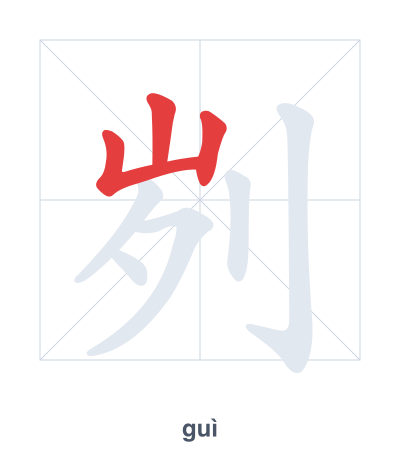
Open Hanzi Writer to see the animated stroke order and practice writing 刿 with real-time feedback.
The character 刿 (guì) is written with 8 strokes. Follow the standard Chinese stroke order: top to bottom, left to right, outside before inside. The radical 刂 is one of its key components.
Practice the correct stroke order with the Hanzi Writer app to see animated stroke-by-stroke guidance with real-time feedback.
刿 means to cut; to wound.
刿 is a phono-semantic compound. The right side radical 刂 (knife) indicates the action of cutting or wounding, while the left side 岁 (suì, year/age) provides a phonetic clue to the pronunciation guì. Together, they depict the idea of inflicting a cut or wound.
💡 Memory Tip: Picture a knife (刂) slicing through a stack of birthday cakes representing years (岁) — a deep cut that wounds for ages.
那个画面很刿目。
nà ge huà miàn hěn guì mù
That scene is eye-piercing and shocking.
这件事让他很刿心。
zhè jiàn shì ràng tā hěn guì xīn
This matter was heart-piercing for him.
寒风刺刿着皮肤。
hán fēng cì guì zhe pí fū
The cold wind cuts against the skin.
Open Hanzi Writer to see the animated stroke order and practice writing 刿 with real-time feedback.
✨ Animated stroke order · Handwriting recognition · HSK-graded practice · Free to use
刿 is composed of the radical 刂 (knife) on the right and the phonetic component 岁 (suì) on the left. The knife radical directly connects to the meaning "to cut" or "to wound," while 岁 provides the pronunciation cue guì. This combination shows that the character blends a sound hint with a meaning hint related to cutting.