崮 (gù) means "Mesa / flat-topped hill" in Chinese. It has 11 strokes with the radical 山.
Rated 4.2/5 in difficulty (advanced).
Appears in 3+ common words including 崮子 (gù zi), 孟良崮 (mèng liáng gù), 岱崮 (dài gù).
Due to its 11 strokes, Hanzi Writer's error detection shows 崮 requires focused practice — most learners need 10+ attempts for consistent accuracy.
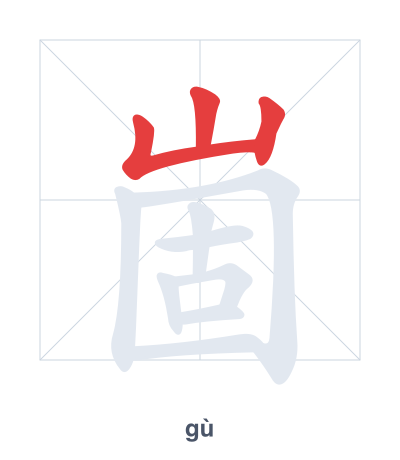
Open Hanzi Writer to see the animated stroke order and practice writing 崮 with real-time feedback.
The character 崮 (gù) is written with 11 strokes. Follow the standard Chinese stroke order: top to bottom, left to right, outside before inside. The radical 山 is one of its key components.
Practice the correct stroke order with the Hanzi Writer app to see animated stroke-by-stroke guidance with real-time feedback.
崮 means Mesa / flat-topped hill.
This character combines the radical 山 (mountain) with 固 (gù, meaning solid or firm). A mesa is a mountain with a flat, solid top, so the components visually suggest a 'solid mountain' shape.
💡 Memory Tip: Picture a mountain (山) whose top is flat and sturdy like a solid (固) table.
这种山叫作崮子。
zhè zhǒng shān jiào zuò gù zi
This type of mountain is called a 'Guzi' (flat-topped hill).
孟良崮很有名。
mèng liáng gù hěn yǒu míng
Menglianggu is very famous.
岱崮在山东省。
dài gù zài shān dōng shěng
Daigu is in Shandong Province.
Open Hanzi Writer to see the animated stroke order and practice writing 崮 with real-time feedback.
✨ Animated stroke order · Handwriting recognition · HSK-graded practice · Free to use
The character 崮 is made of the mountain radical 山 on top and the phonetic component 固 (gù, meaning "solid") below. The radical 山 shows it is a landform, and 固 adds the idea of a firm, solid structure. Together, they describe a flat-topped hill that is stable and strong.