菰 (gū) means "Wild rice (root character)" in Chinese. It has 11 strokes with the radical 艹.
Rated 4.2/5 in difficulty (advanced).
Appears in 3+ common words including 菰米 (gū mǐ), 菰菜 (gū cài), 茭菰 (jiāo gū).
Due to its 11 strokes, Hanzi Writer's error detection shows 菰 requires focused practice — most learners need 10+ attempts for consistent accuracy.
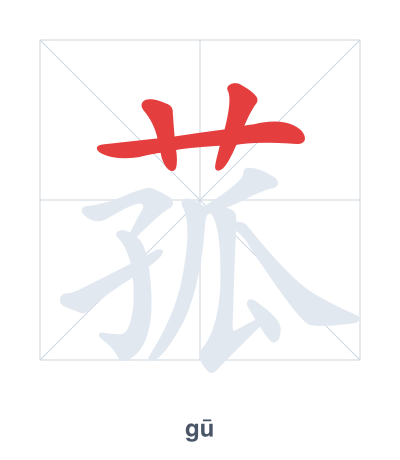
Open Hanzi Writer to see the animated stroke order and practice writing 菰 with real-time feedback.
The character 菰 (gū) is written with 11 strokes. Follow the standard Chinese stroke order: top to bottom, left to right, outside before inside. The radical 艹 is one of its key components.
Practice the correct stroke order with the Hanzi Writer app to see animated stroke-by-stroke guidance with real-time feedback.
菰 means Wild rice (root character).
菰 is a compound character with the grass radical 艹 indicating a plant, and the phonetic component 瓜 (melon) originally supplying the sound gū, while hinting at the edible grain that resembles a tiny melon. Wild rice is actually a type of aquatic grass whose seeds were harvested as food in ancient China.
💡 Memory Tip: Imagine a wild rice stalk (艹) growing out of a waterlogged field, its seed head shaped like a tiny green melon (瓜) bursting with edible grains.
这种菰米很好吃。
zhè zhǒng gū mǐ hěn hǎo chī
This wild rice is delicious.
菰菜是一种蔬菜。
gū cài shì yī zhǒng shū cài
Zizania latifolia is a type of vegetable.
他在市场买茭菰。
tā zài shì chǎng mǎi jiāo gū
He is buying water bamboo at the market.
Open Hanzi Writer to see the animated stroke order and practice writing 菰 with real-time feedback.
✨ Animated stroke order · Handwriting recognition · HSK-graded practice · Free to use
菰 is composed of the grass radical 艹 on top and the phonetic component 瓜 (guā, meaning melon) below. The grass radical indicates it is a type of plant, while 瓜 hints at the pronunciation gū. So the character represents a water plant, wild rice, which grows in grassy wetlands.