茛 (gèn) means "buttercup" in Chinese. It has 9 strokes with the radical 艹.
Rated 4/5 in difficulty (challenging).
Appears in 3+ common words including 茛苕 (gèn sháo), 茛菪 (gèn dàng), 茛绸 (gèn chóu).
Due to its 9 strokes, Hanzi Writer's error detection shows 茛 requires focused practice — most learners need 10+ attempts for consistent accuracy.
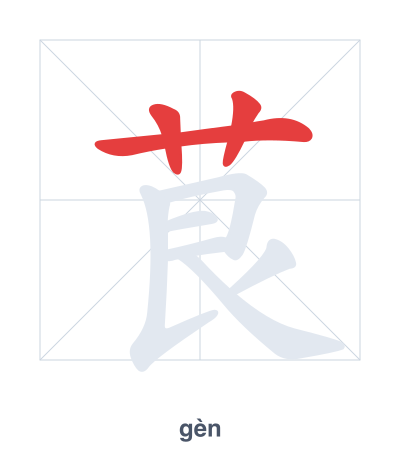
Open Hanzi Writer to see the animated stroke order and practice writing 茛 with real-time feedback.
The character 茛 (gèn) is written with 9 strokes. Follow the standard Chinese stroke order: top to bottom, left to right, outside before inside. The radical 艹 is one of its key components.
Practice the correct stroke order with the Hanzi Writer app to see animated stroke-by-stroke guidance with real-time feedback.
茛 means buttercup.
茛 is a phono-semantic compound: the radical 艹 (grass) indicates it's a plant, and 艮 (gèn) provides the pronunciation. This character specifically refers to the buttercup flower, a common yellow wildflower.
💡 Memory Tip: Picture a stubborn (艮) little weed (艹) that refuses to be pulled, showing off its bright yellow buttercup blooms.
墙上有茛苕花纹。
qiáng shàng yǒu gèn sháo huā wén
There are acanthus patterns on the wall.
这种植物叫茛菪。
zhè zhòng zhí wù jiào gèn dàng
This plant is called henbane.
他穿着一件茛绸衣服。
tā chuān zhe yī jiàn gèn chóu yī fú
He is wearing a gambiered silk garment.
Open Hanzi Writer to see the animated stroke order and practice writing 茛 with real-time feedback.
✨ Animated stroke order · Handwriting recognition · HSK-graded practice · Free to use
The character 茛 is made of two parts: the top radical 艹 (grass) and the bottom component 艮 (gèn). The grass radical shows that 茛 is a plant, like the buttercup flower. The bottom part 艮 provides the sound gèn and also hints at the plant's strong root.