苕 (sháo) means "sweet potato / vetch" in Chinese. It has 8 strokes with the radical 艹.
Rated 3.7/5 in difficulty (challenging).
Appears in 3+ common words including 红苕 (hóng sháo), 苕粉 (sháo fěn), 苕子 (sháo zi).
Due to its 8 strokes, Hanzi Writer's error detection shows 苕 requires focused practice — most learners need 10+ attempts for consistent accuracy.
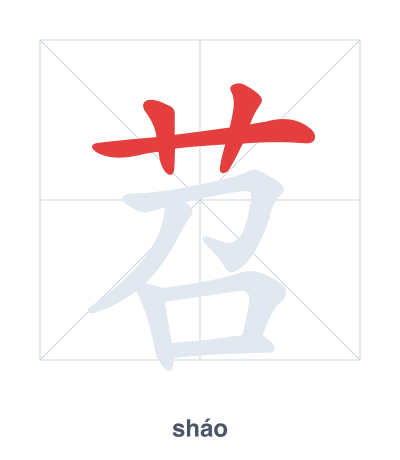
Open Hanzi Writer to see the animated stroke order and practice writing 苕 with real-time feedback.
The character 苕 (sháo) is written with 8 strokes. Follow the standard Chinese stroke order: top to bottom, left to right, outside before inside. The radical 艹 is one of its key components.
Practice the correct stroke order with the Hanzi Writer app to see animated stroke-by-stroke guidance with real-time feedback.
苕 means sweet potato / vetch.
苕 is a phono-semantic compound where the radical 艹 (grass) indicates a plant, and the component 召 (shào/zhào, meaning 'call' or 'summon') hints at the pronunciation sháo. It originally referred to a type of vetch, and later also came to mean sweet potato.
💡 Memory Tip: Picture a sweet potato hiding under grass (艹) and calling out (召) for you to dig it up.
他在吃红苕。
tā zài chī hóng sháo
He is eating sweet potatoes.
这个苕粉很好吃。
zhè ge sháo fěn hěn hǎo chī
These sweet potato noodles are delicious.
地里种了苕子。
dì lǐ zhǒng le sháo zi
Vetch is planted in the field.
Open Hanzi Writer to see the animated stroke order and practice writing 苕 with real-time feedback.
✨ Animated stroke order · Handwriting recognition · HSK-graded practice · Free to use
苕 is made of two parts: the top is 艹 (grass radical) and the bottom is 召 (zhào, to summon). The grass radical shows that 苕 is a plant, and the bottom part 召 gives the sound and suggests the plant's vines 'summon' or spread out, like sweet potato vines or vetch.