硌 (gè) means "To press uncomfortably" in Chinese. It has 11 strokes with the radical 石.
Rated 4.2/5 in difficulty (advanced).
Appears in 3+ common words including 硌脚 (gè jiǎo), 硌牙 (gè yá), 硌得慌 (gè dé huāng).
Due to its 11 strokes, Hanzi Writer's error detection shows 硌 requires focused practice — most learners need 10+ attempts for consistent accuracy.
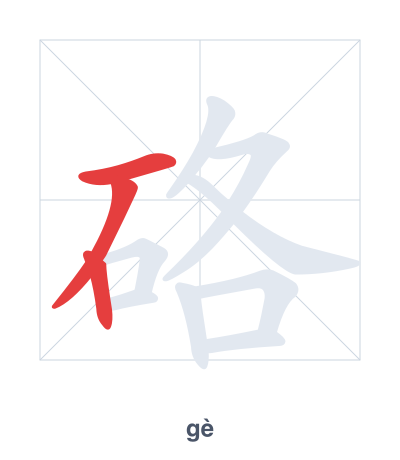
Open Hanzi Writer to see the animated stroke order and practice writing 硌 with real-time feedback.
The character 硌 (gè) is written with 11 strokes. Follow the standard Chinese stroke order: top to bottom, left to right, outside before inside. The radical 石 is one of its key components.
Practice the correct stroke order with the Hanzi Writer app to see animated stroke-by-stroke guidance with real-time feedback.
硌 means To press uncomfortably.
硌 is a phono-semantic compound: the radical 石 (stone) indicates something hard, and 各 (gè) provides the pronunciation. The meaning 'to press uncomfortably' comes from the sensation of a stone or hard object pressing into your body, like stepping on a pebble.
💡 Memory Tip: Imagine a stone (石) that presses into your foot with each (各) step, making you wince in discomfort.
这双鞋有点儿硌脚。
zhè shuāng xié yǒu diǎn ér gè jiǎo
This pair of shoes is a bit uncomfortable on the feet.
米饭里有沙子,硌牙。
mǐ fàn lǐ yǒu shā zi gè yá
There is sand in the rice, it hurts my teeth.
床太硬,躺着硌得慌。
chuáng tài yìng tǎng zhe gè dé huāng
The bed is too hard; it's uncomfortable to lie on.
Open Hanzi Writer to see the animated stroke order and practice writing 硌 with real-time feedback.
✨ Animated stroke order · Handwriting recognition · HSK-graded practice · Free to use
硌 is formed with the radical 石 (stone) on the left and 各 (each) on the right. The stone radical suggests hardness or stone-like objects, while 各 provides the pronunciation gè. Together, they create the idea of a hard stone or object pressing uncomfortably against something, like a stone in a shoe.