绋 (fú) means "A large rope (often used for a hearse)" in Chinese. It has 8 strokes with the radical 纟.
Rated 3.7/5 in difficulty (challenging).
Appears in 3+ common words including 执绋 (zhí fú), 绋索 (fú suǒ), 挽绋 (wǎn fú).
Due to its 8 strokes, Hanzi Writer's error detection shows 绋 requires focused practice — most learners need 10+ attempts for consistent accuracy.
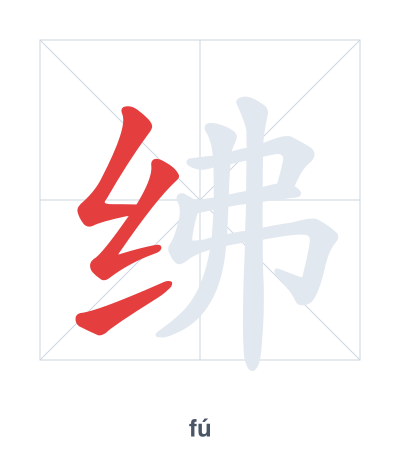
Open Hanzi Writer to see the animated stroke order and practice writing 绋 with real-time feedback.
The character 绋 (fú) is written with 8 strokes. Follow the standard Chinese stroke order: top to bottom, left to right, outside before inside. The radical 纟 is one of its key components.
Practice the correct stroke order with the Hanzi Writer app to see animated stroke-by-stroke guidance with real-time feedback.
绋 means A large rope (often used for a hearse).
绋 combines the silk radical 纟 (thread) with 弗 (fú), a phonetic component. It denotes a large rope, specifically the strong cord used in ancient China to pull a hearse during funeral processions.
💡 Memory Tip: Picture a hearse tied with a huge silk rope twisted into a shape like the letter 'F' for 'funeral'.
很多人来为他执绋。
hěn duō rén lái wèi tā zhí fú
Many people came to attend his funeral.
工人们拉紧了绋索。
gōng rén men lā jǐn le fú suǒ
Workers tightened the ropes.
亲友们在葬礼上挽绋。
qīn yǒu men zài zàng lǐ shàng wǎn fú
Relatives and friends participated in the funeral procession.
Open Hanzi Writer to see the animated stroke order and practice writing 绋 with real-time feedback.
✨ Animated stroke order · Handwriting recognition · HSK-graded practice · Free to use
The character 绋 combines the radical 纟 (silk thread) with the phonetic component 弗 (fú). The silk radical suggests rope or cord, while 弗 provides pronunciation. Together they form the meaning of a large rope, especially one used for a hearse.