酆 (fēng) means "Feng (a surname or place name)" in Chinese. It has 20 strokes with the radical 阝.
Rated 3.9/5 in difficulty (challenging).
Appears in 3+ common words including 酆都 (fēng dōu), 酆城 (fēng chéng), 姓酆 (xìng fēng).
Due to its 20 strokes, Hanzi Writer's error detection shows 酆 requires focused practice — most learners need 10+ attempts for consistent accuracy.
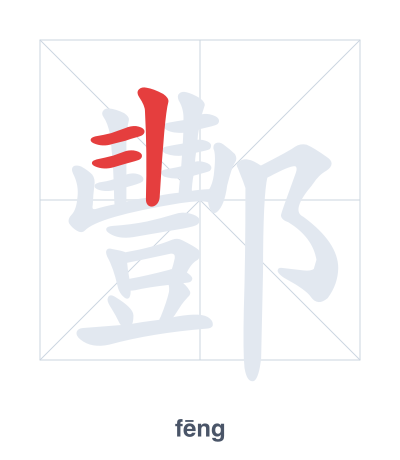
Open Hanzi Writer to see the animated stroke order and practice writing 酆 with real-time feedback.
The character 酆 (fēng) is written with 20 strokes. Follow the standard Chinese stroke order: top to bottom, left to right, outside before inside. The radical 阝 is one of its key components.
Practice the correct stroke order with the Hanzi Writer app to see animated stroke-by-stroke guidance with real-time feedback.
酆 means Feng (a surname or place name).
酆 combines the right-radical 阝 (邑, meaning 'city' or 'town') with 豐 (fēng, 'abundant'), suggesting a place of prosperity. Historically, 酆 was the name of a Zhou-dynasty capital and later a surname, reflecting its origin as a locative character for a bountiful settlement.
💡 Memory Tip: Imagine a bountiful field (豐) beside a city wall (阝) where the Feng family harvests gold.
酆都很有名。
fēng dōu hěn yǒu míng
Fengdu is very famous.
酆城在江西。
fēng chéng zài jiāng xī
Fengcheng is in Jiangxi.
老师姓酆。
lǎo shī xìng fēng
The teacher's surname is Feng.
Open Hanzi Writer to see the animated stroke order and practice writing 酆 with real-time feedback.
✨ Animated stroke order · Handwriting recognition · HSK-graded practice · Free to use
酆 is composed of the radical 阝 (city on the right) and the phonetic component 豐 (fēng). The 阝 indicates it is related to a place name, while 豐 provides the pronunciation and originally meant "abundant," but here it just functions as a sound element.