狒 (fèi) means "Baboon" in Chinese. It has 8 strokes with the radical 犭.
Rated 3.7/5 in difficulty (challenging).
Appears in 3+ common words including 狒狒 (fèi fèi), 大狒狒 (dà fèi fèi), 狒狒群 (fèi fèi qún).
Due to its 8 strokes, Hanzi Writer's error detection shows 狒 requires focused practice — most learners need 10+ attempts for consistent accuracy.
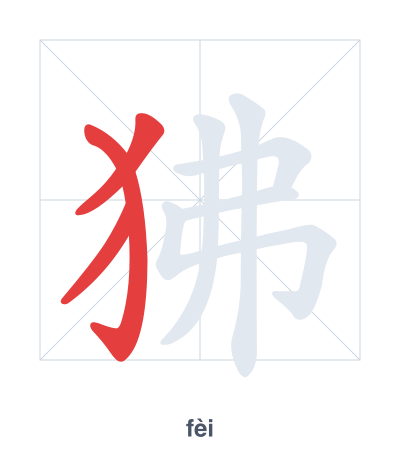
Open Hanzi Writer to see the animated stroke order and practice writing 狒 with real-time feedback.
The character 狒 (fèi) is written with 8 strokes. Follow the standard Chinese stroke order: top to bottom, left to right, outside before inside. The radical 犭 is one of its key components.
Practice the correct stroke order with the Hanzi Writer app to see animated stroke-by-stroke guidance with real-time feedback.
狒 means Baboon.
狒 is a phono-semantic compound. The radical 犭 (dog/animal) indicates it is a type of animal, while 弗 provides the pronunciation fèi. The character specifically denotes the baboon, a large primate.
💡 Memory Tip: Imagine a baboon with a dog-like body (犭) and two crossed bows (弗) on its back, shooting bananas at you while screaming 'Fee!'
动物园里有几只狒狒。
dòng wù yuán lǐ yǒu jǐ zhī fèi fèi
There are several baboons in the zoo.
那是一只巨大的狒狒。
nà shì yī zhī jù dà de fèi fèi
That is a huge baboon.
狒狒群在树林里活动。
fèi fèi qún zài shù lín lǐ huó dòng
A troop of baboons is active in the woods.
Open Hanzi Writer to see the animated stroke order and practice writing 狒 with real-time feedback.
✨ Animated stroke order · Handwriting recognition · HSK-graded practice · Free to use
狒 uses the radical 犭, which means 'dog' or 'animal', on the left. The right part 弗 (fú) provides the pronunciation. Together, they form a character for a type of primate, the baboon.