蒽 (ēn) means "Anthracene" in Chinese. It has 13 strokes with the radical 艹.
Rated 4.2/5 in difficulty (advanced).
Appears in 3+ common words including 蒽油 (ēn yóu), 蒽醌 (ēn kūn), 蒽蓝 (ēn lán).
Due to its 13 strokes, Hanzi Writer's error detection shows 蒽 requires focused practice — most learners need 10+ attempts for consistent accuracy.
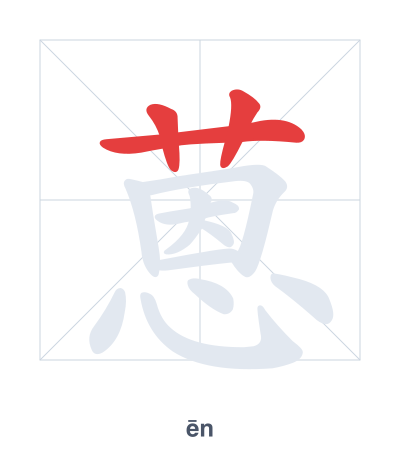
Open Hanzi Writer to see the animated stroke order and practice writing 蒽 with real-time feedback.
The character 蒽 (ēn) is written with 13 strokes. Follow the standard Chinese stroke order: top to bottom, left to right, outside before inside. The radical 艹 is one of its key components.
Practice the correct stroke order with the Hanzi Writer app to see animated stroke-by-stroke guidance with real-time feedback.
蒽 means Anthracene.
蒽 is a modern compound character combining the grass radical 艹 (indicating an organic compound) with 恩 (ēn, meaning 'favor' or 'kindness') as a phonetic component to represent the pronunciation. It was created as a chemical term for anthracene, a hydrocarbon derived from coal tar, following the pattern of naming organic substances with the 艹 radical (like 苯 for benzene).
💡 Memory Tip: Picture a grass blade (艹) sprouting a heart (心 from 恩) that glows with fiery anthracene rings—a kind (恩) plant that secretly burns with chemical energy.
这种油叫蒽油。
zhè zhǒng yóu jiào ēn yóu
This oil is called anthracene oil.
蒽醌有颜色。
ēn kūn yǒu yán sè
Anthraquinone has color.
这是蒽蓝染料。
zhè shì ēn lán rǎn liào
This is anthracene blue dye.
Open Hanzi Writer to see the animated stroke order and practice writing 蒽 with real-time feedback.
✨ Animated stroke order · Handwriting recognition · HSK-graded practice · Free to use
蒽 has the grass radical 艹 on top and 恩 (ēn, meaning kindness or gratitude) below. The grass radical suggests it is a plant-derived substance, and 恩 provides the pronunciation. The character represents anthracene, a chemical compound originally extracted from coal tar, which comes from organic plant matter.