锝 (dé) means "Technetium" in Chinese. It has 13 strokes with the radical 钅.
Rated 4.2/5 in difficulty (advanced).
Appears in 3+ common words including 锝元素 (dé yuán sù), 锝原子 (dé yuán zi), 提取锝 (tí qǔ dé).
Due to its 13 strokes, Hanzi Writer's error detection shows 锝 requires focused practice — most learners need 10+ attempts for consistent accuracy.
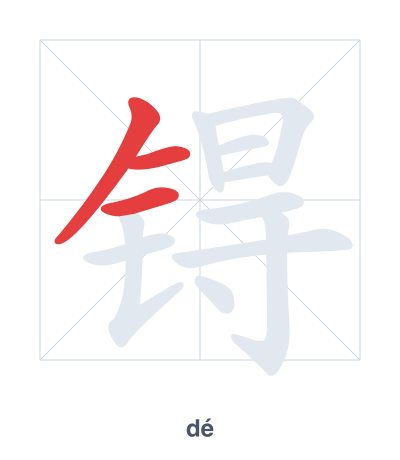
Open Hanzi Writer to see the animated stroke order and practice writing 锝 with real-time feedback.
The character 锝 (dé) is written with 13 strokes. Follow the standard Chinese stroke order: top to bottom, left to right, outside before inside. The radical 钅 is one of its key components.
Practice the correct stroke order with the Hanzi Writer app to see animated stroke-by-stroke guidance with real-time feedback.
锝 means Technetium.
锝 is a phono-semantic compound: the radical 钅 (metal) indicates it is a metallic element, and 得 (dé, meaning 'to obtain') provides the pronunciation. Technetium was the first artificially produced element, symbolizing the idea of 'obtaining' a new metal through nuclear synthesis.
💡 Memory Tip: Picture a metal (钅) scientist who finally obtains (得) a glowing vial of technetium after a long, difficult experiment.
锝元素是人工合成的。
dé yuán sù shì rén gōng hé chéng de
Technetium is a synthetic element.
锝原子在医学上有用。
dé yuán zi zài yī xué shàng yǒu yòng
Technetium atoms are useful in medicine.
他们正在提取锝。
tā men zhèng zài tí qǔ dé
They are extracting technetium.
Open Hanzi Writer to see the animated stroke order and practice writing 锝 with real-time feedback.
✨ Animated stroke order · Handwriting recognition · HSK-graded practice · Free to use
The left side 钅 is the metal radical, indicating that 锝 is a metallic element. The right side 得 (dé) gives the pronunciation and also hints at the idea of 'obtaining' because technetium was the first element artificially obtained in a lab.