赕 (dǎn) means "to offer gifts to Buddha (in Dai culture)" in Chinese. It has 12 strokes with the radical 贝.
Rated 4.2/5 in difficulty (advanced).
Appears in 3+ common words including 赕佛 (dǎn fú), 赕钱 (dǎn qián), 赕物 (dǎn wù).
Due to its 12 strokes, Hanzi Writer's error detection shows 赕 requires focused practice — most learners need 10+ attempts for consistent accuracy.
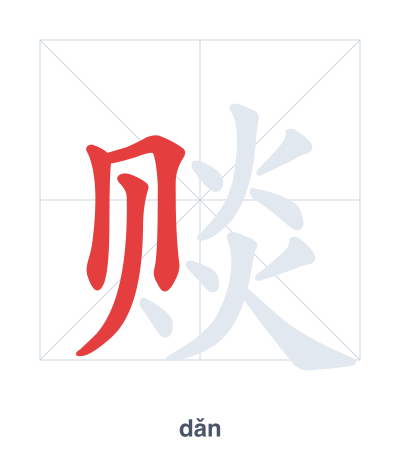
Open Hanzi Writer to see the animated stroke order and practice writing 赕 with real-time feedback.
The character 赕 (dǎn) is written with 12 strokes. Follow the standard Chinese stroke order: top to bottom, left to right, outside before inside. The radical 贝 is one of its key components.
Practice the correct stroke order with the Hanzi Writer app to see animated stroke-by-stroke guidance with real-time feedback.
赕 means to offer gifts to Buddha (in Dai culture).
The character 赕 combines the radical 贝 (shell, representing wealth or gifts) with 炎 (two flames, suggesting fire or burning). In Dai culture, offerings to Buddha often involve burning incense or items, so the character visually conveys 'valuable gifts given with fiery devotion.'
💡 Memory Tip: Picture a stack of money (贝) being thrown into two flames (炎) as a generous gift to Buddha.
他们去寺庙赕佛。
tā men qù sì miào dǎn fú
They went to the temple to make offerings to Buddha.
这里的赕钱很多。
zhè lǐ de dǎn qián hěn duō
There is a lot of tribute money here.
他准备了赕物。
tā zhǔn bèi le dǎn wù
He prepared the tribute offerings.
Open Hanzi Writer to see the animated stroke order and practice writing 赕 with real-time feedback.
✨ Animated stroke order · Handwriting recognition · HSK-graded practice · Free to use
The character 赕 is made of the radical 贝 (shell, money) on the left and the phonetic component 覃 on the right. The 贝 radical connects the character to money or valuable items, which relates to offering gifts. The right side 覃 provides the approximate pronunciation dǎn.