眈 (dān) means "to glare; to gaze intently" in Chinese. It has 9 strokes with the radical 目.
Rated 4/5 in difficulty (challenging).
Appears in 3+ common words including 虎视眈眈 (hǔ shì dān dān), 眈眈 (dān dān), 眈视 (dān shì).
Due to its 9 strokes, Hanzi Writer's error detection shows 眈 requires focused practice — most learners need 10+ attempts for consistent accuracy.
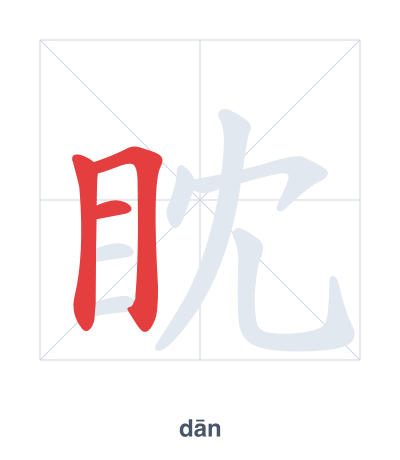
Open Hanzi Writer to see the animated stroke order and practice writing 眈 with real-time feedback.
The character 眈 (dān) is written with 9 strokes. Follow the standard Chinese stroke order: top to bottom, left to right, outside before inside. The radical 目 is one of its key components.
Practice the correct stroke order with the Hanzi Writer app to see animated stroke-by-stroke guidance with real-time feedback.
眈 means to glare; to gaze intently.
眈 is a compound character combining the radical 目 (eye) with the phonetic component 冘, which originally depicted a person carrying a burden but here only contributes sound. The eye radical directly conveys the meaning of a fixed, intense gaze—as if glaring at something with great focus.
💡 Memory Tip: Picture an eye (目) glaring angrily at a person (冘) who is sneaking away, so intensely that the person freezes.
他虎视眈眈地看着食物。
tā hǔ shì dān dān dì kàn zhe shí wù
He glared at the food like a tiger eyeing its prey.
他眈眈地注视着前方。
tā dān dān dì zhù shì zhe qián fāng
He stared ahead intensely.
老鹰在空中眈视猎物。
lǎo yīng zài kōng zhōng dān shì liè wù
The eagle is watching its prey from the sky.
Open Hanzi Writer to see the animated stroke order and practice writing 眈 with real-time feedback.
✨ Animated stroke order · Handwriting recognition · HSK-graded practice · Free to use
眈 is made of the radical 目 (eye) on the left and the phonetic component 冘 on the right. The eye radical directly connects to the meaning of staring or glaring, while 冘 provides the sound dān. Together they create a character that describes intense gazing.