绐 (dài) means "To deceive or cheat (literary)." in Chinese. It has 8 strokes with the radical 纟.
Rated 3.7/5 in difficulty (challenging).
Appears in 3+ common words including 绐骗 (dài piàn), 绐语 (dài yǔ), 绐弄 (dài nòng).
Due to its 8 strokes, Hanzi Writer's error detection shows 绐 requires focused practice — most learners need 10+ attempts for consistent accuracy.
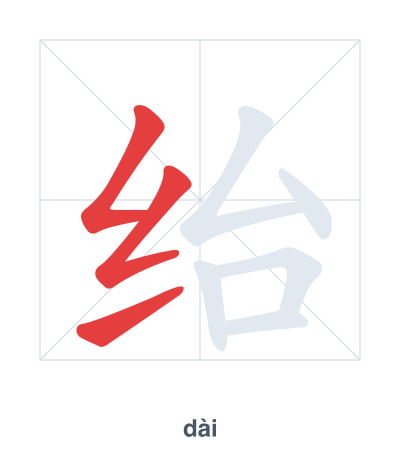
Open Hanzi Writer to see the animated stroke order and practice writing 绐 with real-time feedback.
The character 绐 (dài) is written with 8 strokes. Follow the standard Chinese stroke order: top to bottom, left to right, outside before inside. The radical 纟 is one of its key components.
Practice the correct stroke order with the Hanzi Writer app to see animated stroke-by-stroke guidance with real-time feedback.
绐 means To deceive or cheat (literary)..
绐 is a phono-semantic compound: the silk radical (纟) hints at the idea of entangling or ensnaring, while 台 (tái) provides the pronunciation. In classical texts, it describes using deceptive words or actions to trap someone, much like a silken thread that tangles unbeknownst.
💡 Memory Tip: Imagine a stage performer (台) using silk threads (纟) to pull a hidden rope and make a prop fall—tricking the audience into thinking it was magic.
他想绐骗那个老人。
tā xiǎng dài piàn nà ge lǎo rén
He wants to deceive that old man.
他的话全是绐语。
tā de huà quán shì dài yǔ
His words were all lies.
你不要随便绐弄人。
nǐ bú yào suí biàn dài nòng rén
Don't just fool people.
Open Hanzi Writer to see the animated stroke order and practice writing 绐 with real-time feedback.
✨ Animated stroke order · Handwriting recognition · HSK-graded practice · Free to use
绐 is a left-right character. The left side 纟 (silk radical) often appears in characters related to threads or binding, while the right side 台 gives the sound dài. Together they create a literary character meaning 'to deceive', though the silk radical's connection is not literal here.