Hanzi Writer

How to Write 綷 (cuì) — Meaning “multicolored; sound of clothes rubbing”

cuì 14 strokes Radical: 糸

綷 (cuì) means "multicolored; sound of clothes rubbing" in Chinese. It has 14 strokes with the radical 糸.

Rated 4.2/5 in difficulty (advanced).

Appears in 3+ common words including 綷縩 (cuì cài), 綷烂 (cuì làn), 綷五 (cuì wǔ).

Due to its 14 strokes, Hanzi Writer's error detection shows 綷 requires focused practice — most learners need 10+ attempts for consistent accuracy.
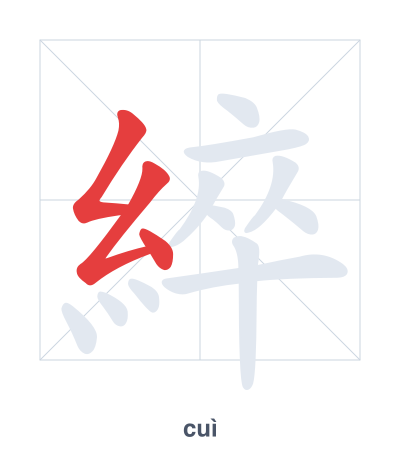
Stroke order practice for 綷 - cuì

Practice Writing 綷 (cuì)

Open Hanzi Writer to see the animated stroke order and practice writing 綷 with real-time feedback.

The character (cuì) is written with 14 strokes. Follow the standard Chinese stroke order: top to bottom, left to right, outside before inside. The radical is one of its key components.

Practice the correct stroke order with the Hanzi Writer app to see animated stroke-by-stroke guidance with real-time feedback.

means multicolored; sound of clothes rubbing.

Character
Pinyincuì (cui)
Meaningmulticolored; sound of clothes rubbing
Strokes14
Radical
Difficulty4.2/5

綷 combines the silk radical 糸 (mì) with the phonetic component 翠 (cuì, kingfisher), whose vibrant feathers symbolize the meaning of multicolored silk or the rustling sound of clothes.

💡 Memory Tip: Imagine a kingfisher (翠) with dazzling feathers brushing against silk (糸), creating a rustling rainbow of sound and color.

cuì cài
rustling sound of silk clothes
cuì làn
bright and colorful; brilliant
cuì wǔ
five-colored; multicolored

衣服发出綷縩声。

yī fú fā chū cuì cài shēng

The clothes made a rustling sound.

颜色看起来很綷烂。

yán sè kàn qǐ lái hěn cuì làn

The colors look bright and colorful.

綷五之色很漂亮。

cuì wǔ zhī sè hěn piào liàng

The five-colored patterns are very beautiful.

Character Pinyin Strokes Radical
(current) cuì 14
12
guà 12
12
Stroke order practice for 綷 - cuì

Practice Writing 綷 (cuì)

Open Hanzi Writer to see the animated stroke order and practice writing 綷 with real-time feedback.

✨ Animated stroke order · Handwriting recognition · HSK-graded practice · Free to use

Frequently Asked Questions about 綷

綷 is made of two parts: the radical 糸 (silk) on the left, and the phonetic component 卒 (zú) on the right. The silk radical links it to fabric and clothing, while 卒 contributes to the pronunciation cuì. Together, these parts suggest the character's meanings of multicolored silk or the rustling sound of silk clothes.

Characters with Radical 糸

Other 14-Stroke Characters